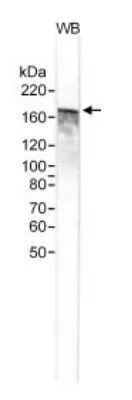
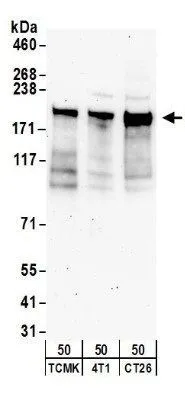
GTX10491
NCOA2 antibody

Cannot supply to this region.
- SKU:
- GTX10491
- Additional Names:
- nuclear receptor coactivator 2 , GRIP1 , KAT13C , NCoA-2 , SRC2 , TIF2 , bHLHe75
- Application:
- WB, IP
- Concentration:
- 1 mg/ml
- Physical State:
- Liquid
- Species Reactivity:
- Human
- Purification:
- Affinity Purified
- Storage Conditions:
- 2-8[o]C Do not freeze.
- Supplier:
- Genetex
- Host:
- Rabbit
- Reactivities:
- Human, Mouse
- Buffer:
- Tris-Citrate/Phosphate, 0.09% Sodium azide.
- Immunogen:
- The immunogen recognized by this antibody maps to a region between residues 700 and 750 of human Nuclear Receptor Coactivator 2 using the numbering given in entry NP_006531.1 (GeneID 10499).
- Uniprot:
- Q15596
- Synonyms:
- bHLHe75;class E basic helix-loop-helix protein 75;glucocorticoid receptor-interacting protein-1;GRIP1;KAT13C;NCoA-2;nuclear receptor coactivator 2;p160 steroid receptor coactivator 2;SRC2;TIF2;transcriptional intermediary factor 2
- Extra Details:
- The NCOA2 gene encodes nuclear receptor coactivator 2, which aids in the function of nuclear hormone receptors. Nuclear hormone receptors are conditional transcription factors that play important roles in various aspects of cell growth, development, and homeostasis by controlling expression of specific genes. Members of the nuclear hormone receptor superfamily, which includes the 5 steroid receptors and class II nuclear receptors (see below), are structurally characterized by 3 distinct domains: an N-terminal transcriptional activation domain, a central DNA-binding domain, and a C-terminal hormone-binding domain. Before the binding of hormone, steroid receptors, which are sometimes called class I of the nuclear hormone receptor family, remain inactive in a complex with heat-shock protein-90 (MIM 140571) and other stress family proteins. Binding of hormone induces critical conformational changes in steroid receptors that cause them to dissociate from the inhibitory complex, bind as homodimers to specific DNA enhancer elements associated with target genes, and modulate that gene's transcription. After binding to enhancer elements, transcription factors require transcriptional coactivator proteins to mediate their stimulation of transcription initiation (Hong et al., 1997 [PubMed 9111344]).[supplied by OMIM]
- Shipping Conditions:
- Blue Ice