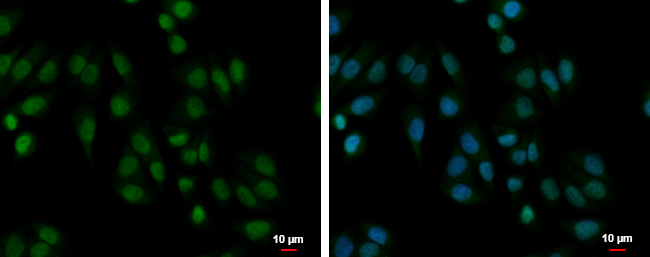
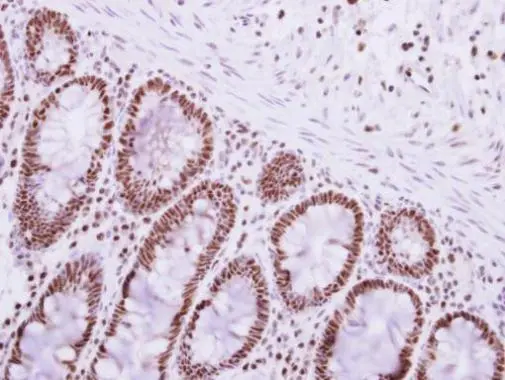
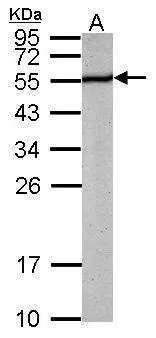
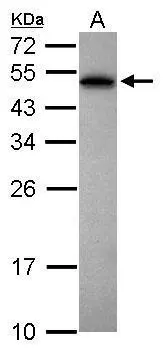
GTX101490
PABPN1 antibody

Cannot supply to this region.
- SKU:
- GTX101490
- Additional Names:
- poly(A) binding protein nuclear 1 , OPMD , PAB2 , PABII , PABP-2 , PABP2
- Application:
- WB, IHC-P, IHC-Fr, IF, ICC
- Concentration:
- 0.49 mg/ml
- Physical State:
- Liquid
- Species Reactivity:
- Human
- Purification:
- Affinity Purified
- Storage Conditions:
- -20[o]C Aliquot. Avoid freeze/thaw cycles. Store undiluted., 2-8[o]C Aliquot. Avoid freeze/thaw cycles. Store undiluted., -20[o]C/-70[o]C Aliquot. Avoid freeze/thaw cycles. Store undiluted.
- Supplier:
- Genetex
- Host:
- Rabbit
- Reactivities:
- Human, Mouse
- Buffer:
- PBS, 1% BSA, 20% Glycerol, 0.01% Thimerosal.
- Immunogen:
- Recombinant protein encompassing a sequence within the center region of human PABPN1. The exact sequence is proprietary.
- Uniprot:
- Q86U42
- Synonyms:
- Nuclear poly(A)-binding protein 1;OPMD;PAB2;PABII;PABP-2;PABP2;poly(A) binding protein 2;poly(A) binding protein II;Poly(A)-binding protein II;Polyadenylate-binding nuclear protein 1;polyadenylate-binding protein 2
- Extra Details:
- This gene encodes an abundant nuclear protein that binds with high affinity to nascent poly(A) tails. The protein is required for progressive and efficient polymerization of poly(A) tails on the 3' ends of eukaryotic genes and controls the size of the poly(A) tail to about 250 nt. At steady-state, this protein is localized in the nucleus whereas a different poly(A) binding protein is localized in the cytoplasm. An expansion of the trinucleotide (GCG) repeat from normal 6 to 8-13 at the 5' end of the coding region of this gene leads to autosomal dominant oculopharyngeal muscular dystrophy (OPMD) disease. Multiple splice variants have been described but their full-length nature is not known. One splice variant includes introns 1 and 6 but no protein is formed. [provided by RefSeq]
- Shipping Conditions:
- Blue Ice