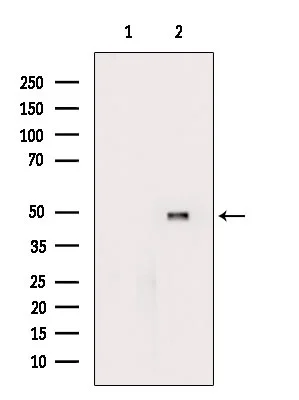
GTX04636
EDA antibody

Cannot supply to this region.
- SKU:
- GTX04636
- Additional Names:
- ectodysplasin A , ECTD1 , ED1 , ED1-A1 , ED1-A2 , EDA-A1 , EDA-A2 , EDA1 , EDA2 , HED , HED1 , ODT1 , STHAGX1 , TNLG7C , XHED , XLHED
- Application:
- WB
- Concentration:
- 1 mg/ml
- Physical State:
- Liquid
- Species Reactivity:
- Human, Rat
- Purification:
- Affinity Purified
- Storage Conditions:
- -20[o]C Aliquot. Avoid freeze/thaw cycles. Store undiluted., 2-8[o]C Aliquot. Avoid freeze/thaw cycles. Store undiluted., -20[o]C/-70[o]C Aliquot. Avoid freeze/thaw cycles. Store undiluted.
- Supplier:
- Genetex
- Host:
- Rabbit
- Reactivities:
- Rat
- Buffer:
- PBS, 150mM NaCl, 50% Glycerol, 0.02% sodium azide.
- Immunogen:
- A synthesized peptide derived from human EDA(Accession Q92838), corresponding to amino acid residues L136-G186.
- Uniprot:
- Q92838
- Synonyms:
- ECTD1;Ectodermal dysplasia protein;ectodysplasin-A;ED1;ED1-A1;ED1-A2;EDA-A1;EDA-A2;EDA1;EDA2;HED;HED1;ODT1;oligodontia 1;STHAGX1;TNLG7C;tumor necrosis factor ligand 7C;X-linked anhidroitic ectodermal dysplasia protein;XHED;XLHED
- Extra Details:
- The protein encoded by this gene is a type II membrane protein that can be cleaved by furin to produce a secreted form. The encoded protein, which belongs to the tumor necrosis factor family, acts as a homotrimer and may be involved in cell-cell signaling during the development of ectodermal organs. Defects in this gene are a cause of ectodermal dysplasia, anhidrotic, which is also known as X-linked hypohidrotic ectodermal dysplasia. Several transcript variants encoding many different isoforms have been found for this gene. [provided by RefSeq, Jul 2008]
- Shipping Conditions:
- Blue Ice