GTX01177
ASIC3 antibody

Cannot supply to this region.
- SKU:
- GTX01177
- Additional Names:
- acid sensing ion channel subunit 3 , ACCN3 , ASIC3 , DRASIC , SLNAC1 , TNaC1
- Application:
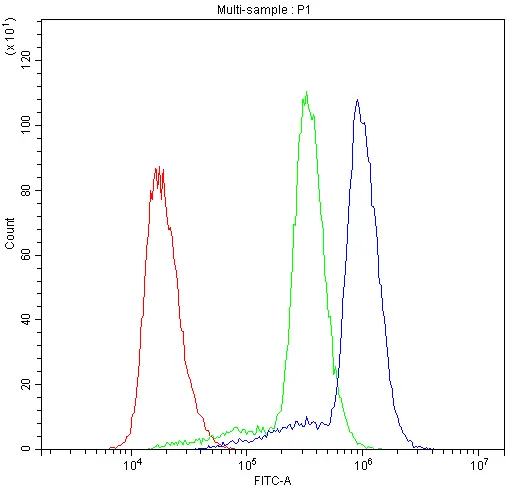
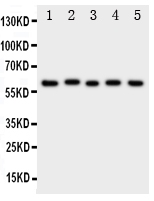
- Flow Cytometry, WB
- Concentration:
- 0.5 mg/ml
- Physical State:
- Liquid
- Species Reactivity:
- Human
- Purification:
- Affinity Purified
- Storage Conditions:
- -20[o]C Aliquot. Avoid freeze/thaw cycles. Store undiluted., 2-8[o]C Aliquot. Avoid freeze/thaw cycles. Store undiluted., -20[o]C/-70[o]C Aliquot. Avoid freeze/thaw cycles. Store undiluted.
- Supplier:
- Genetex
- Host:
- Rabbit
- Reactivities:
- Human, Mouse, Rat
- Buffer:
- 5mg BSA, 0.9mg NaCl, 0.2mg Na₂HPO₄, 0.05mg Thimerosal, 0.05mg Sodium azide.
- Immunogen:
- A synthetic peptide corresponding to a sequence at the N-terminus of human ASIC3(56-73aa FLYQVAERVRYYREFHHQ).
- Uniprot:
- Q9UHC3
- Synonyms:
- ACCN3;acid sensing (proton gated) ion channel 3;acid-sensing ion channel 3;Amiloride-sensitive cation channel 3;amiloride-sensitive cation channel 3, testis;DRASIC;modulatory subunit of ASIC2a;neuronal amiloride-sensitive cation channel 3;proton-gated cation channel subunit;SLNAC1;testis sodium channel 1;TNaC1
- Extra Details:
- This gene encodes a member of the degenerin/epithelial sodium channel (DEG/ENaC) superfamily. The members of this family are amiloride-sensitive sodium channels that contain intracellular N and C termini, two hydrophobic transmembrane regions, and a large extracellular loop, which has many cysteine residues with conserved spacing. The member encoded by this gene is an acid sensor and may play an important role in the detection of lasting pH changes. In addition, a heteromeric association between this member and acid-sensing (proton-gated) ion channel 2 has been observed as proton-gated channels sensitive to gadolinium. Alternatively spliced transcript variants have been described. [provided by RefSeq, Feb 2012]
- Shipping Conditions:
- Blue Ice