

RP01712
Recombinant Human FGF-4 Protein

Size
£145.00
- SKU:
- RP01712
- Additional Names:
- FGF-4|FGF4|HBGF-4|HST|HST-1|HSTF-1|HSTF1|K-FGF|KFGF
- Molecular Weight:
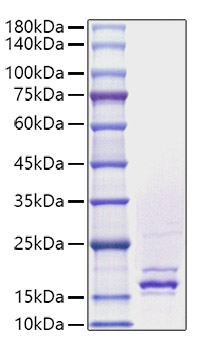
- 20 kDa
- Purity:
- ≥95%
- Storage Conditions:
- -20[o]C reconstituted. Avoid freeze/thaw cycles., 2-8[o]C reconstituted., -20[o]C/-70[o]C lyophilized. Avoid freeze/thaw cycles.
- Supplier:
- Abclonal
- Immunogen:
- Gly25-Leu206
- Formulation:
- Recombinant Human FGF-4 Protein is produced by E. coli expression system. The target protein is expressed with sequence (Gly25-Leu206) of human FGF-4 (Accession #NP_001998.1) fused with no additional amino acid.
- Species:
- Human
- Sequence:
- GRGGAAAPTAPNGTLEAELERRWESLVALSLARLPVAAQPKEAAVQSGAGDYLLGIKRLRRLYCNVGIGFHLQALPDGRIGGAHADTRDSLLELSPVERGVVSIFGVASRFFVAMSSKGKLYGSPFFTDECTFKEILLPNNYNAYESYKYPGMFIALSKNGKTKKGNRVSPTMKVTHFLPRL
- Uniprot:
- P08620-1
- Synonyms:
- FGF-4;fibroblast growth factor 4;HBGF-4;heparin secretory transforming protein 1;Heparin secretory-transforming protein 1;heparin-binding growth factor 4;HST;HST-1;HSTF-1;HSTF1;human stomach cancer, transforming factor from FGF-related oncogene;K-FGF;kaposi sarcoma oncogene;KFGF;oncogene HST;transforming protein KS3
- Extra Details:
- FGF (fibroblast growth factor) signalling is known to be required for many aspects of mesoderm formation and patterning during Xenopus development and has been implicated in regulating genes required for the specification of both blood and skeletal muscle lineages. Fibroblast growth factor 4 (FGF4) signaling induces differentiation from embryonic stem cells (ESCs) via the phosphorylation of downstream molecules such as mitogen-activated protein kinase/extracellular signal-related kinase (MEK) and extracellular signal-related kinase 1/2 (ERK1/2). Fibroblast Growth Factor 4 (FGF-4) could not only increase the proliferation of bone marrow mesenchymal stem cells (BMSCs), but also induce BMSCs into hepatocyte-like cells in vitro. FGF4 transduced BMSCs contributed to liver regeneration might by the transplanted microenvironment. The FGF4-bFGF BMSCs thus can enhance the survival of the transplanted cells, diminish myocardial fibrosis, promote myocardial angiogenesis, and improve cardiac functions.
- Shipping Conditions:
- Blue Ice