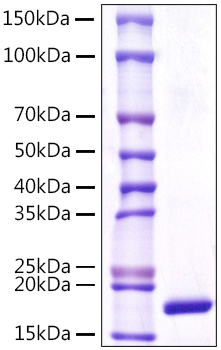

RP01533
Recombinant Human Lipocalin-1/LCN1 Protein

Size
POA
- SKU:
- RP01533
- Additional Names:
- LCN1,PMFA,TLC,TP,VEGP
- Molecular Weight:
- 18-20 kDa
- Purity:
- ≥95%
- Storage Conditions:
- -20[o]C reconstituted. Avoid freeze/thaw cycles., 2-8[o]C reconstituted., -20[o]C/-70[o]C lyophilized. Avoid freeze/thaw cycles.
- Supplier:
- Abclonal
- Immunogen:
- His19-Asp176
- Formulation:
- Recombinant Human Lipocalin-1/LCN1 Protein is produced by HEK293 cells expression system. The target protein is expressed with sequence (His19-Asp176) of human Lipocalin-1/LCN1 (Accession #NP_002288.1) fused with a 6xHis tag at the C-terminus.
- Species:
- Human
- Sequence:
- HHLLASDEEIQDVSGTWYLKAMTVDREFPEMNLESVTPMTLTTLEGGNLEAKVTMLISGRCQEVKAVLEKTDEPGKYTADGGKHVAYIIRSHVKDHYIFYCEGELHGKPVRGVKLVGRDPKNNLEALEDFEKAAGARGLSTESILIPRQSETCSPGSD
- Uniprot:
- P31025
- Synonyms:
- lipocalin-1;PMFA;protein migrating faster than albumin;Tear lipocalin;tear prealbumin;TLC;TP;VEG protein;VEGP;Von Ebner gland protein
- Extra Details:
- Lipocalin-1, also known as Von Ebner gland protein, VEG protein, Tear Prealbumin, VEGP, Tear lipocalin, and LCN1 is a secreted protein that belongs to the calycin superfamily and Lipocalin family. Human Lipocalin-1 / VEGP was originally described as a major protein of human tear fluid, which was thought to be tear specific. Lipocalin-1 / VEGP is identical to lingual von Ebner's gland protein and is also produced in the prostate, nasal mucosa, and tracheal mucosa. Homologous proteins have been found in the rat, pig, and probably dog and horse. Lipocalin-1 / VEGP is an unusual lipocalin member, because of its high promiscuity for relative insoluble lipids and binding characteristics that differ from other members. Lipocalin-1 / VEGP acts as the principal lipid-binding protein in tear fluid, a more general physiological function has to be proposed due to its wide distribution and properties. Lipocalin-1 / VEGP would be ideally suited for scavenging of lipophilic, potentially harmful substances and thus might act as a general protection factor of epithelia. Lipocalin-1 / LCN1 could play a role in taste reception. It could be necessary for the concentration and delivery of sapid molecules in the gustatory system. Lipocalin-1 / LCN1 can bind various ligands, with chemical structures ranging from lipids and retinoids to the macrocyclic antibiotic rifampicin and even to microbial siderophores. It exhibits an extremely wide ligand pocket.
- Shipping Conditions:
- Blue Ice