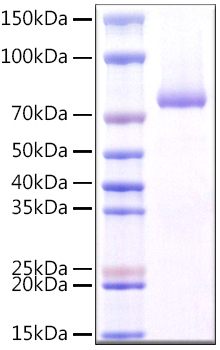

RP01523
Recombinant Human CLEC7A/Dectin-1/CD369 Protein

Size
£133.00
- SKU:
- RP01523
- Additional Names:
- CLEC7A,BGR,CANDF4,CLECSF12,DECTIN1,SCARE2,CD369
- Molecular Weight:
- 70-80 kDa
- Purity:
- ≥95%
- Storage Conditions:
- -20[o]C reconstituted. Avoid freeze/thaw cycles., 2-8[o]C reconstituted., -20[o]C/-70[o]C lyophilized. Avoid freeze/thaw cycles.
- Supplier:
- Abclonal
- Immunogen:
- Thr66-Met247
- Formulation:
- Recombinant Human CLEC7A/Dectin-1/CD369 Protein is produced by HEK293 cells expression system. The target protein is expressed with sequence (Thr66-Met247) of human CLEC7A/Dectin-1/CD369 (Accession #NP_922938.1) fused with a raFc tag at the N-terminus.
- Species:
- Human
- Sequence:
- TMAIWRSNSGSNTLENGYFLSRNKENHSQPTQSSLEDSVTPTKAVKTTGVLSSPCPPNWIIYEKSCYLFSMSLNSWDGSKRQCWQLGSNLLKIDSSNELGFIVKQVSSQPDNSFWIGLSRPQTEVPWLWEDGSTFSSNLFQIRTTATQENPSPNCVWIHVSVIYDQLCSVPSYSICEKKFSM
- Uniprot:
- Q9BXN2
- Synonyms:
- beta-glucan receptor;BGR;C-type (calcium dependent, carbohydrate-recognition domain) lectin, superfamily member 12;C-type lectin domain family 7 member A;C-type lectin superfamily member 12;CANDF4;CD369;CLECSF12;DC-associated C-type lectin 1;dectin-1;DECTIN1;Dendritic cell-associated C-type lectin 1;dendritic cell-associated C-type lectin-1;lectin-like receptor 1;SCARE2
- Extra Details:
- Dectin-1 was recently identified as the most important receptor for beta-glucan. It is a type II transmembrane protein which binds beta-1,3 and beta-1,6 glucans, and is expressed on most cells of the innate immune system and has been implicated in phagocytosis as well as killing of fungi by macrophages, neutrophils and dendritic cells. Recognition of beta-glucan by dectin-1 triggers effective immune response, including phagocytosis and proinflammatory factor production, to eliminate infecting fungi, which especially benefits immunocompromised patients against opportunistic fungal infection. In addition, dectin-1 is involved in the adaptive immune response as well as autoimmune diseases and immune tolerance. Dectin-1 can recognize and respond to live fungal pathogens and is being increasingly appreciated as having a key role in the innate responses to these pathogens. In addition to its exogenous ligands, Dectin-1 can recognize an unidentified endogenous ligand on T cells and may act as a co-stimulatory molecule. Recent studies have highlighted the importance of Dectin-1 in anti-fungal immunity, in both mice and humans, and have suggested a possible involvement of this receptor in the control of mycobacterial infections.
- Shipping Conditions:
- Blue Ice