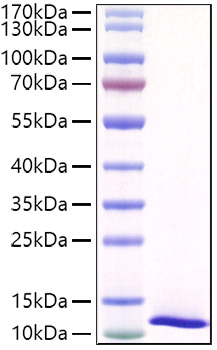

RP01487
Recombinant Mouse SPINK4 Protein

Size
£145.00
- SKU:
- RP01487
- Additional Names:
- SPINK4,MPGC60,SPINK4
- Molecular Weight:
- 10-15 kDa
- Purity:
- ≥95%
- Storage Conditions:
- -20[o]C reconstituted. Avoid freeze/thaw cycles., 2-8[o]C reconstituted., -20[o]C/-70[o]C lyophilized. Avoid freeze/thaw cycles.
- Supplier:
- Abclonal
- Immunogen:
- Gly27-Cys86
- Formulation:
- Recombinant Mouse SPINK4 Protein is produced by HEK293 cells expression system. The target protein is expressed with sequence (Gly27-Cys86) of mouse SPINK4/MPGC60 (Accession #NP_035593.2) fused with a 6xHis tag at the C-terminus.
- Species:
- Mouse
- Sequence:
- GSLVFPRMPFCEHMAELPNCPQTPNLICGTDGLTYENECHLCLTRMKTMKDIQIMKDGQC
- Uniprot:
- O35679
- Synonyms:
- MPGC6;MPGC60;MPGC60 protein;peptide PEC-60 homolog;serine protease inhibitor Kazal-type 4
- Extra Details:
- Serine protease inhibitor Kazal-type 4, also known as Peptide PEC-6 homolog and SPINK4, is a secreted protein that contains one Kazal-like domain. SPINK4 is a member of the SPINK protein family. The gene family of serine protease inhibitors of the Kazal type (SPINK) are functional and positional candidate genes for celiac disease (CD). SPINK1 plays an important role in protecting the pancreas against excessive trypsinogen activation. It is a potent natural inhibitor of pancreatic trypsin activity. SPINK1 mutations are associated with the development of acute and chronic pancreatitis and have been detected in all forms of chronic pancreatitis. SPINK2 functions as a trypsin/acrosin inhibitor and is synthesized mainly in the testis and seminal vesicle where its activity is engaged infertility. The SPINK2 protein contains a typical Kazal domain composed by six cysteine residues forming three disulfide bridges. SPINK9 was identified in human skin. Its expression was strong in palmar epidermis, but not detectable or very low in non palmoplantar skin.
- Shipping Conditions:
- Blue Ice