

RP01363
Recombinant Human IGFBP-3 Protein

Size
£133.00
- SKU:
- RP01363
- Additional Names:
- IGFBP3,BP-53,IBP3
- Molecular Weight:
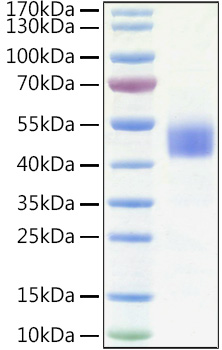
- 40-50 kDa
- Purity:
- ≥95%
- Storage Conditions:
- -20[o]C reconstituted. Avoid freeze/thaw cycles., 2-8[o]C reconstituted., -20[o]C/-70[o]C lyophilized. Avoid freeze/thaw cycles.
- Supplier:
- Abclonal
- Immunogen:
- Gly28-Lys291
- Formulation:
- Recombinant Human IGFBP-3 Protein is produced by HEK293 cells expression system. The target protein is expressed with sequence (Gly28-Lys291) of human IGFBP3/BP-53 (Accession #NP_000589.2) fused with a 6xHis tag at the C-terminus.
- Species:
- Human
- Sequence:
- GASSAGLGPVVRCEPCDARALAQCAPPPAVCAELVREPGCGCCLTCALSEGQPCGIYTERCGSGLRCQPSPDEARPLQALLDGRGLCVNASAVSRLRAYLLPAPPAPGNASESEEDRSAGSVESPSVSSTHRVSDPKFHPLHSKIIIIKKGHAKDSQRYKVDYESQSTDTQNFSSESKRETEYGPCRREMEDTLNHLKFLNVLSPRGVHIPNCDKKGFYKKKQCRPSKGRKRGFCWCVDKYGQPLPGYTTKGKEDVHCYSMQSK
- Uniprot:
- P17936-1
- Synonyms:
- acid stable subunit of the 140 K IGF complex;binding protein 29;binding protein 53;BP-53;growth hormone-dependent binding protein;IBP-3;IBP3;IGF-binding protein 3;IGFBP-3;insulin-like growth factor-binding protein 3
- Extra Details:
- The Insulin-like Growth Factor (IGF) signaling system plays a central role in cellular growth, differentiation, and proliferation. IGFBP3 is the most abundant IGF binding protein in human serum and is a growth inhibitory, apoptosis-inducing molecule, capable of acting via IGF-dependent and IGF-independent mechanisms. It appears to function both by cell cycle blockade and the induction of apoptosis. IGFBP3 can be transported to the nucleus by an importin beta mediated mechanism, where it has been shown to interact with the retinoid X receptor alpha and possibly other nuclear elements. IGFBP3 antiproliferative signaling appears to require an active transforming growth factor-beta (TGF-beta) signaling pathway, and IGFBP3 stimulates phosphorylation of the TGF-beta signaling intermediates Smad2 and Smad3. IGFBP3 has IGF-independent roles in inhibiting cell proliferation in cancer cell lines. Nuclear transcription factor, retinoid X receptor (RXR)-alpha, and IGFBP3 functionally interact to reduce prostate tumor growth and prostate-specific antigen in vivo. Several clinical studies have proposed that individuals with IGFBP3 levels in the upper range of normal may have a decreased risk for certain common cancers. This includes evidence of a protective effect against breast cancer, prostate cancer, colorectal cancer, and lung cancer. Moreover, IGFBP3 inhibits insulin-stimulated glucose uptake into adipocytes independent of IGF.
- Shipping Conditions:
- Blue Ice