

RP01336
Recombinant Human TNFSF14/LIGHT/HVEM-L/CD258 Protein

Size
£133.00
- SKU:
- RP01336
- Additional Names:
- TNFSF14,CD258,HVEML,LIGHT,LTg
- Molecular Weight:
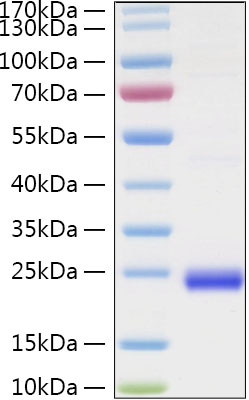
- 20-25 kDa
- Purity:
- ≥95%
- Storage Conditions:
- -20[o]C reconstituted. Avoid freeze/thaw cycles., 2-8[o]C reconstituted., -20[o]C/-70[o]C lyophilized. Avoid freeze/thaw cycles.
- Supplier:
- Abclonal
- Immunogen:
- Asp74-Val240
- Formulation:
- Recombinant Human TNFSF14/LIGHT/HVEM-L/CD258 Protein is produced by HEK293 cells expression system. The target protein is expressed with sequence (Asp74-Val240) of Human TNFSF14 (Accession #NP_003798.2) fused with a 6xHis tag at the N-terminus.
- Species:
- Human
- Sequence:
- DGPAGSWEQLIQERRSHEVNPAAHLTGANSSLTGSGGPLLWETQLGLAFLRGLSYHDGAL VVTKAGYYYIYSKVQLGGVGCPLGLASTITHGLYKRTPRYPEELELLVSQQSPCGRATSS SRVWWDSSFLGGVVHLEAGEKVVVRVLDERLVRLRDGTRSYFGAFMV
- Uniprot:
- O43557
- Synonyms:
- CD258;Herpes virus entry mediator ligand;herpesvirus entry mediator ligand;HVEML;LIGHT;LTg;tumor necrosis factor (ligand) superfamily, member 14;tumor necrosis factor ligand 1D;tumor necrosis factor ligand superfamily member 14;tumor necrosis factor superfamily member 14
- Extra Details:
- LIGHT, also known as TNFSF14 or CD258, is a newly identified member of the TNF superfamily (TNFSF14) that is expressed by activated T lymphocytes, monocytes, granulocytes, spleen cells, and immature dendritic cells. TNFSF14 / LIGHT / CD258 is a type II transmembrane protein that is known to bind 2 membrane-bound TNFSF signaling receptors: HVEM, which is predominantly expressed by T cells, and lymphotoxin B Beta receptor (LTB BetaR), which is expressed by stromal cells and nonlymphoid hematopoietic cells. TNFSF14 / LIGHT / CD258 also binds to a soluble non-signaling receptor, decoy receptor 3 (DcR3), which can modulate the function of LIGHT in vivo. TNFSF14 / LIGHT / CD258 can also costimulate T cell responses via HVEM, which is constitutively expressed in most lymphocyte subpopulations, including CD4+and CD8+T cells. In addition, TNFSF14 / LIGHT / CD258 has been shown to suppress tumor formation in vivo and to induce tumor cell apoptosis via the up-regulation of intercellular adhesion molecule 1 and an increased lymphocyte adhesion to cancer cells. Thus, TNFSF14 / LIGHT / CD258 is being actively investigated as a possible basis for cancer treatment.
- Shipping Conditions:
- Blue Ice