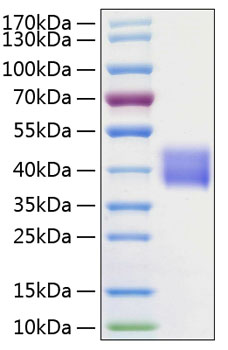

RP00078
Recombinant Human Kallikrein-1/KLK1 Protein

Size
POA
- SKU:
- RP00078
- Additional Names:
- KLK1,KLKR,Klk6,hK1
- Molecular Weight:
- 38-50 kDa
- Purity:
- ≥95%
- Storage Conditions:
- -20[o]C reconstituted. Avoid freeze/thaw cycles., 2-8[o]C reconstituted., -20[o]C/-70[o]C lyophilized. Avoid freeze/thaw cycles.
- Supplier:
- Abclonal
- Immunogen:
- Met1-Ser262
- Formulation:
- Recombinant Human Kallikrein-1/KLK1 Protein is produced by HEK293 expression system. The target protein is expressed with sequence (Met 1-Ser 262) of human Kallikrein 1 (Accession #NP_002248) fused with a 6xHis tag at the C-terminus.
- Species:
- Human
- Sequence:
- MWFLVLCLALSLGGTGAAPPIQSRIVGGWECEQHSQPWQAALYHFSTFQCGGILVHRQWVLTAAHCISDNYQLWLGRHNLFDDENTAQFVHVSESFPHPGFNMSLLENHTRQADEDYSHDLMLLRLTEPADTITDAVKVVELPTEEPEVGSTCLASGWGSIEPENFSFPDDLQCVDLKILPNDECKKAHVQKVTDFMLCVGHLEGGKDTCVGDSGGPLMCDGVLQGVTSWGYVPCGTPNKPSVAVRVLSYVKWIEDTIAENS
- Uniprot:
- P06870
- Synonyms:
- glandular kallikrein 1;hK1;kallikrein 1, renal/pancreas/salivary;kallikrein serine protease 1;kallikrein-1;kidney/pancreas/salivary gland kallikrein;Klk6;KLKR;tissue kallikrein
- Extra Details:
- This protein is the class A macrophage scavenger receptors, which include three different types (1, 2, 3) generated by alternative splicing of this gene. These receptors or isoforms are macrophage-specific trimeric integral membrane glycoproteins and have been implicated in many macrophage-associated physiological and pathological processes including atherosclerosis, Alzheimer's disease, and host defense. The isoforms type 1 and type 2 are functional receptors and are able to mediate the endocytosis of modified low density lipoproteins (LDLs). The isoform type 3 does not internalize modified LDL (acetyl-LDL) despite having the domain shown to mediate this function in the types 1 and 2 isoforms. It has an altered intracellular processing and is trapped within the endoplasmic reticulum, making it unable to perform endocytosis. The isoform type 3 can inhibit the function of isoforms type 1 and type 2 when co-expressed, indicating a dominant negative effect and suggesting a mechanism for regulation of scavenger receptor activity in macrophages.
- Shipping Conditions:
- Blue Ice