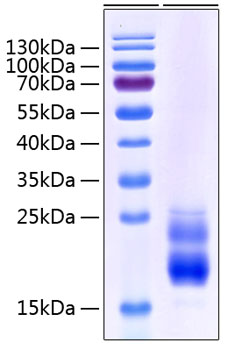

RP00077
Recombinant Human CD69 Protein

Size
£133.00
- SKU:
- RP00077
- Additional Names:
- CD69,AIM,BL-AC/P26,CLEC2C,EA1,GP32/28,MLR-3
- Molecular Weight:
- 15-35 kDa
- Purity:
- ≥95%
- Storage Conditions:
- -20[o]C reconstituted. Avoid freeze/thaw cycles., 2-8[o]C reconstituted., -20[o]C/-70[o]C lyophilized. Avoid freeze/thaw cycles.
- Supplier:
- Abclonal
- Immunogen:
- Ser62-Lys199
- Formulation:
- Recombinant Human CD69 Protein is produced by HEK293 expression system. The target protein is expressed with sequence (Ser 62 - Lys 199 ) of human CD69 (Accession #NP_001772.1) fused with a 6xHis tag at the C-terminus.
- Species:
- Human
- Sequence:
- SVGQYNCPGQYTFSMPSDSHVSSCSEDWVGYQRKCYFISTVKRSWTSAQNACSEHGATLAVIDSEKDMNFLKRYAGREEHWVGLKKEPGHPWKWSNGKEFNNWFNVTGSDKCVFLKNTEVSSMECEKNLYWICNKPYK
- Uniprot:
- Q07108
- Synonyms:
- Activation inducer molecule;activation inducer molecule (AIM/CD69);AIM;BL-AC/P26;C-type lectin domain family 2 member C;C-type lectin domain family 2, member C;CD69 antigen (p60, early T-cell activation antigen);CLEC2C;EA1;early activation antigen CD69;early lymphocyte activation antigen;early T-cell activation antigen p60;GP32/28;leukocyte surface antigen Leu-23;MLR-3
- Extra Details:
- Early activation antigen CD69, also known as activation inducer molecule (AIM), is a single-pass type II membrane protein. Recently, cDNA clones encoding human and mouse CD69 were isolated and showed CD69 to be a member of the C-type lectin superfamily. It is one of the earliest cell surface antigens expressed by T cells following activation. Once expressed, CD69 acts as a costimulatory molecule for T cell activation and proliferation. In addition to mature T cells, CD69 is inducibly expressed by immature thymocytes, B cells, natural killer (NK) cells, monocytes, neutrophils and eosinophils, and is constitutively expressed by mature thymocytes and platelets. CD69 is involved in lymphocyte proliferation and functions as a signal transmitting receptor in lymphocytes, natural killer (NK) cells, and platelets. The structure, chromosomal localization, expression and function of CD69 suggest that it is likely a pleiotropic immune regulator , potentially important in the activation and differentiation of a wide variety of hematopoietic cells. This membrane molecule transiently expresses on activated lymphocytes, and its selective expression in inflammatory infiltrates suggests that it plays a role in the pathogenesis of inflammatory diseases. CD69 plays a crucial role in the pathogenesis of allergen-induced eosinophilic airway inflammation and hyperresponsiveness and that CD69 could be a possible therapeutic target for asthmatic patients.
- Shipping Conditions:
- Blue Ice