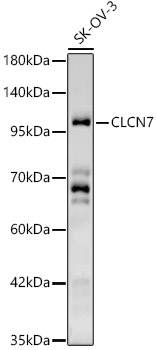

A6886
CLCN7 Rabbit polyclonal antibody

Size
£152.00
- SKU:
- A6886
- Additional Names:
- CLC-7|CLC7|CLCN7|HOD|OPTA2|OPTB4|PPP1R63
- Application:
- ELISA, WB
- Molecular Weight:
- 110kDa
- Species Reactivity:
- Human
- Purification:
- Affinity Purified
- Storage Conditions:
- -20[o]C Avoid freeze/thaw cycles.
- Supplier:
- Abclonal
- Host:
- Rabbit
- Reactivities:
- Human, Mouse, Rat
- Immunogen:
- Recombinant protein (or fragment).This information is considered to be commercially sensitive.
- Formulation:
- Unmodified
- Sequence:
- TAREVMSTPVTCLRRREKVGVIVDVLSDTASNHNGFPVVEHADDTQPARLQGLILRSQLIVLLKHKVFVERSNLGLVQRRLRLKDFRDAYPRFPPIQSIHVSQDERECTMDLSEFMNPSPYTVPQEASLPRVFKLFRALGLRHLVVVDNRNQVVGLVTRKDLARYRLGKRGLEELSLAQT
- Uniprot:
- P51798
- Synonyms:
- chloride channel 7 alpha subunit;chloride channel protein 7;chloride channel, voltage-sensitive 7;CLC-7;CLC7;H(+)/Cl(-) exchange transporter 7;HOD;OPTA2;OPTB4;PPP1R63;protein phosphatase 1, regulatory subunit 63
- Extra Details:
- The product of this gene belongs to the CLC chloride channel family of proteins. Chloride channels play important roles in the plasma membrane and in intracellular organelles. This gene encodes chloride channel 7. Defects in this gene are the cause of osteopetrosis autosomal recessive type 4 (OPTB4), also called infantile malignant osteopetrosis type 2 as well as the cause of autosomal dominant osteopetrosis type 2 (OPTA2), also called autosomal dominant Albers-Schonberg disease or marble disease autosoml dominant. Osteopetrosis is a rare genetic disease characterized by abnormally dense bone, due to defective resorption of immature bone. OPTA2 is the most common form of osteopetrosis, occurring in adolescence or adulthood.
- Shipping Conditions:
- Blue Ice