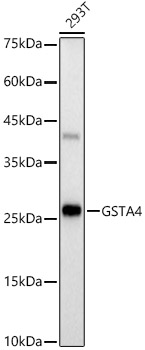
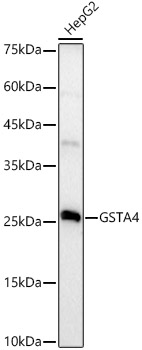


A23555
GSTA4 Rabbit monoclonal antibody

Size
POA
- SKU:
- A23555
- Additional Names:
- GSTA4|GSTA4-4|GTA4
- Application:
- ELISA, WB
- Molecular Weight:
- 26kDa
- Species Reactivity:
- Human
- Purification:
- Affinity Purified
- Storage Conditions:
- -20[o]C Avoid freeze/thaw cycles.
- Supplier:
- Abclonal
- Host:
- Rabbit
- Reactivities:
- Human
- Immunogen:
- Recombinant protein (or fragment).This information is considered to be commercially sensitive.
- Formulation:
- Unmodified
- Sequence:
- MAARPKLHYPNGRGRMESVRWVLAAAGVEFDEEFLETKEQLYKLQDGNHLLFQQVPMVEIDGMKLVQTRSILHYIADKHNLFGKNLKERTLIDMYVEGTL
- Uniprot:
- O15217
- Synonyms:
- glutathione S-alkyltransferase A4;glutathione S-aralkyltransferase A4;glutathione S-aryltransferase A4;glutathione S-transferase A4;glutathione S-transferase A4-4;glutathione transferase A4-4;GST class-alpha member 4;GSTA4-4;GTA4;S-(hydroxyalkyl)glutathione lyase A4
- Extra Details:
- Cytosolic and membrane-bound forms of glutathione S-transferase are encoded by two distinct supergene families. These enzymes are involved in cellular defense against toxic, carcinogenic, and pharmacologically active electrophilic compounds. At present, eight distinct classes of the soluble cytoplasmic mammalian glutathione S-transferases have been identified: alpha, kappa, mu, omega, pi, sigma, theta and zeta. This gene encodes a glutathione S-tranferase belonging to the alpha class. The alpha class genes, which are located in a cluster on chromosome 6, are highly related and encode enzymes with glutathione peroxidase activity that function in the detoxification of lipid peroxidation products. Reactive electrophiles produced by oxidative metabolism have been linked to a number of degenerative diseases including Parkinson's disease, Alzheimer's disease, cataract formation, and atherosclerosis.
- Shipping Conditions:
- Blue Ice