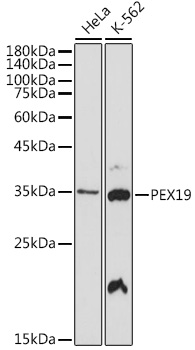

A19237
PEX19 Rabbit monoclonal antibody

Size
POA
- SKU:
- A19237
- Additional Names:
- D1S2223E|HK33|PBD12A|PEX19|PMP1|PMPI|PXF|PXMP1
- Application:
- ELISA, WB
- Molecular Weight:
- 35kda
- Species Reactivity:
- Human
- Purification:
- Affinity Purified
- Storage Conditions:
- -20[o]C Avoid freeze/thaw cycles.
- Supplier:
- Abclonal
- Host:
- Rabbit
- Reactivities:
- Human
- Immunogen:
- Synthetic peptide. This information is considered to be commercially sensitive.
- Formulation:
- Unmodified
- Sequence:
- MAAAEEGCSVGAEADRELEELLESALDDFDKAKPSPAPPSTTTAPDASGPQKRSPGDTAKDALFASQEKFFQELFDSELASQATAEFEKAMKELAEEEPH
- Uniprot:
- P40855
- Synonyms:
- 33 kDa housekeeping protein;D1S2223E;HK33;housekeeping gene, 33kD;PBD12A;peroxin-19;peroxisomal biogenesis factor 19;peroxisomal farnesylated protein;PMP1;PMPI;PXF;PXMP1
- Extra Details:
- This gene is necessary for early peroxisomal biogenesis. It acts both as a cytosolic chaperone and as an import receptor for peroxisomal membrane proteins (PMPs). Peroxins (PEXs) are proteins that are essential for the assembly of functional peroxisomes. The peroxisome biogenesis disorders (PBDs) are a group of genetically heterogeneous autosomal recessive, lethal diseases characterized by multiple defects in peroxisome function. These disorders have at least 14 complementation groups, with more than one phenotype being observed for some complementation groups. Although the clinical features of PBD patients vary, cells from all PBD patients exhibit a defect in the import of one or more classes of peroxisomal matrix proteins into the organelle. Defects in this gene are a cause of Zellweger syndrome (ZWS), as well as peroxisome biogenesis disorder complementation group 14 (PBD-CG14), which is also known as PBD-CGJ. Alternative splicing results in multiple transcript variants.
- Shipping Conditions:
- Blue Ice