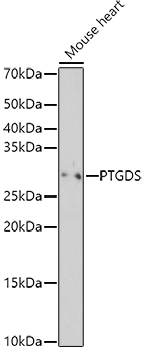

A1889
PTGDS Rabbit polyclonal antibody

Size
£152.00
- SKU:
- A1889
- Additional Names:
- L-PGDS|LPGDS|PDS|PGD2|PGDS|PGDS2|PTGDS
- Application:
- ELISA, WB, IF, ICC
- Molecular Weight:
- 28 kDa
- Species Reactivity:
- Human
- Purification:
- Affinity Purified
- Storage Conditions:
- -20[o]C Avoid freeze/thaw cycles.
- Supplier:
- Abclonal
- Host:
- Rabbit
- Reactivities:
- Human, Mouse, Rat
- Immunogen:
- Recombinant protein (or fragment).This information is considered to be commercially sensitive.
- Formulation:
- Unmodified
- Sequence:
- APEAQVSVQPNFQQDKFLGRWFSAGLASNSSWLREKKAALSMCKSVVAPATDGGLNLTSTFLRKNQCETRTMLLQPAGSLGSYSYRSPHWGSTYSVSVVETDYDQYALLYSQGSKGPGEDFRMATLYSRTQTPRAELKEKFTAFCKAQGFTEDTIVFLPQTDKCMTEQ
- Uniprot:
- P41222
- Synonyms:
- beta-trace protein;cerebrin-28;glutathione-independent PGD synthase;glutathione-independent PGD synthetase;L-PGDS;lipocalin-type prostaglandin D synthase;Lipocalin-type prostaglandin-D synthase;LPGDS;PDS;PGD2;PGD2 synthase;PGDS;PGDS2;prostaglandin D synthase;prostaglandin D2 synthase 21kDa (brain);Prostaglandin-D2 synthase;prostaglandin-H2 D-isomerase;testis tissue sperm-binding protein Li 63n
- Extra Details:
- The protein encoded by this gene is a glutathione-independent prostaglandin D synthase that catalyzes the conversion of prostaglandin H2 (PGH2) to postaglandin D2 (PGD2). PGD2 functions as a neuromodulator as well as a trophic factor in the central nervous system. PGD2 is also involved in smooth muscle contraction/relaxation and is a potent inhibitor of platelet aggregation. This gene is preferentially expressed in brain. Studies with transgenic mice overexpressing this gene suggest that this gene may be also involved in the regulation of non-rapid eye movement sleep.
- Shipping Conditions:
- Blue Ice