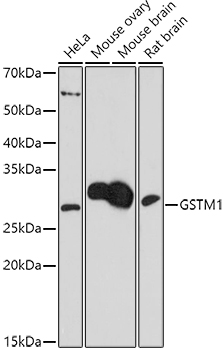

A17492
GSTM1 Rabbit polyclonal antibody

Size
£152.00
- SKU:
- A17492
- Additional Names:
- GST1|GSTM1|GSTM1-1|GSTM1a-1a|GSTM1b-1b|GTH4|GTM1|H-B|MU|MU-1
- Application:
- ELISA, WB
- Molecular Weight:
- 28kDa
- Species Reactivity:
- Human
- Purification:
- Affinity Purified
- Storage Conditions:
- -20[o]C 50% glycerol. Avoid freeze/thaw cycles.
- Supplier:
- Abclonal
- Host:
- Rabbit
- Reactivities:
- Human, Mouse, Rat
- Immunogen:
- Recombinant protein (or fragment).This information is considered to be commercially sensitive.
- Formulation:
- Unmodified
- Sequence:
- MPMILGYWDIRGLAHAIRLLLEYTDSSYEEKKYTMGDAPDYDRSQWLNEKFKLGLDFPNLPYLIDGAHKITQSNAILCYIARKHNLCGETEEEKIRVDILENQTMDNHMQLGMICYNPEFEKLKPKYLEELPEKLKLYSEFLGKRPWFAGNKGLEKISAYMKSSRFLPRPVFSKMAVWGNK
- Uniprot:
- P09488
- Synonyms:
- glutathione S-alkyltransferase;glutathione S-aralkyltransferase;glutathione S-aryltransferase;glutathione S-transferase M1;glutathione S-transferase Mu 1;GST class-mu 1;GST HB subunit 4;GST1;GSTM1-1;GSTM1a-1a;GSTM1b-1b;GTH4;GTM1;H-B;HB subunit 4;MU;MU-1;S-(hydroxyalkyl)glutathione lyase
- Extra Details:
- Cytosolic and membrane-bound forms of glutathione S-transferase are encoded by two distinct supergene families. At present, eight distinct classes of the soluble cytoplasmic mammalian glutathione S-transferases have been identified: alpha, kappa, mu, omega, pi, sigma, theta and zeta. This gene encodes a glutathione S-transferase that belongs to the mu class. The mu class of enzymes functions in the detoxification of electrophilic compounds, including carcinogens, therapeutic drugs, environmental toxins and products of oxidative stress, by conjugation with glutathione. The genes encoding the mu class of enzymes are organized in a gene cluster on chromosome 1p13.3 and are known to be highly polymorphic. These genetic variations can change an individual's susceptibility to carcinogens and toxins as well as affect the toxicity and efficacy of certain drugs. Null mutations of this class mu gene have been linked with an increase in a number of cancers, likely due to an increased susceptibility to environmental toxins and carcinogens. Multiple protein isoforms are encoded by transcript variants of this gene.
- Shipping Conditions:
- Blue Ice