Visualising lipids and tracking their metabolism
To understand the diverse roles lipids play in cell biology, researchers need methods that reveal their localisation and behaviour within cells. However, unlike proteins, lipids are produced through metabolic pathways rather than genetically encoded, so cannot be readily tracked using fluorescent protein tags such as green fluorescent protein (1). Their dynamic metabolism and movement between cellular compartments create further challenges for tracking them over time. To overcome these challenges, researchers use specialised fluorescent tools that can visualise lipid-rich structures or report on lipid metabolism.
Lipid droplets
One approach to visualising intracellular lipids is to stain lipid droplets. These dynamic organelles store neutral lipids, providing reserves for energy production and membrane synthesis while helping regulate lipid availability and metabolism (2). Notably, changes in lipid droplet abundance and distribution can provide insight into altered lipid metabolism in areas such as metabolic disease, atherosclerosis and other cellular stress states.
In studying lipid droplets, researchers commonly use fluorescent dyes that accumulate in lipid-rich structures, making lipid droplets visible under fluorescence microscopy.
Funakoshi’s LipiDye™ II is a highly specific fluorescent stain for live-cell lipid droplet imaging. Its low cytotoxicity and high photostability support long-term imaging, including studies of lipid droplet dynamics and small droplets[OS1] .
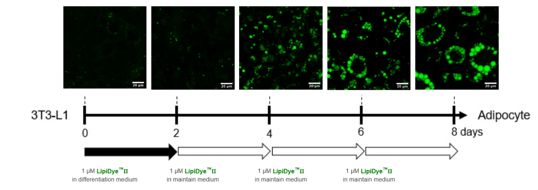
Figure 1. Long-term live-cell imaging of lipid droplet formation during adipocyte differentiation using LipiDye™ II. Image: Funakoshi Co., Ltd.
Fatty-acid uptake and oxidation
Visualising lipid localisation provides important spatial information, but understanding lipid biology also requires insight into how lipids are acquired, transported and metabolised within cells.
One method is to track fatty-acid uptake and processing within cells, which can reveal how cells acquire, distribute and use fatty acids under different conditions. Funakoshi’s LipiDye™-M is a fluorescent fatty-acid tracer that is taken up by cells and incorporated into different lipid species. Its fluorescence changes according to the surrounding environment, allowing researchers to track intracellular fatty-acid metabolism and localisation using multicolour imaging.
Researchers can also monitor fatty-acid oxidation, where fatty acids are broken down through β-oxidation (FAO) to support cellular energy production, providing insight into how cells use fatty acids as an energy source (3). Funakoshi’s FAOBlue™ uses blue fluorescence to measure FAO activity, allowing researchers to compare FAO between cell types and assess compounds that promote or inhibit fatty-acid oxidation.
Measuring lipid signalling and interactions
Lipids also play important roles in cell signalling through interactions with proteins and other cellular components. As a result, researchers study not only where lipids are located, but also how they contribute to signalling pathways. To investigate lipid signalling and interactions, researchers use a variety of approaches. Some measure the abundance of membrane lipids involved in signalling, while others test which lipids specific proteins bind to.
One important group of signalling lipids is the phosphoinositides (PIPs), which are found mainly on the inner surface of cellular membranes. They act as docking sites for proteins, helping to organise and activate signalling pathways (4). Echelon Biosciences’ PIP3 Mass ELISA Kit provides a straightforward way to quantify PIP3 extracted from cell samples using a competitive ELISA. This allows researchers to compare PIP3 levels across experimental conditions in a familiar plate-based format.
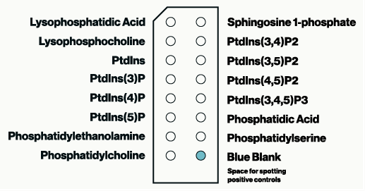
Beyond measuring lipid abundance, researchers can also investigate which lipids particular proteins bind to. Echelon Biosciences’ PIP Strips™ provide a simple membrane-based screen containing eight phosphoinositides and seven other biologically relevant lipids, allowing researchers to assess the lipid-binding specificity of proteins of interest[OS1]