SPC-747
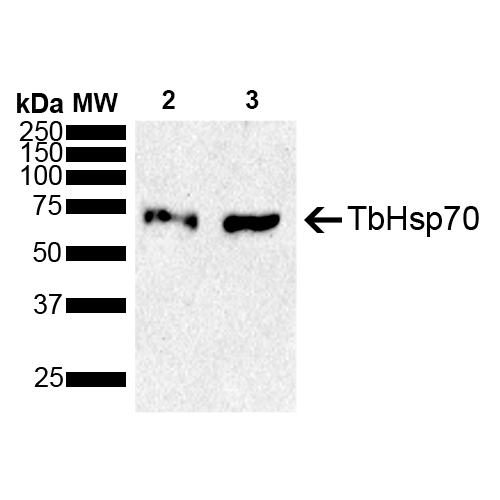
TbHsp70 Antibody

Eine Lieferung in diese Region ist nicht möglich.
- SKU:
- SPC-747
- Zusätzliche Namen:
- TbHsp70, Heat shock 70 kDa protein 4, HSP70-4
- Anwendung:
- WB
- Konzentration:
- 1 mg/ml
- Spezies-Reaktivität:
- Parasite/Protozoa
- Aufreinigung:
- Affinity Purified
- Lagerbedingungen:
- -20[o]C
- Hersteller:
- StressMarq Biosciences
- Host:
- Rabbit
- Reaktivitäten:
- Bacteria, Parasite
- ABP:
- IMP-GEN-2015-06 < 10% Serum <100ml
- Buffer:
- PBS pH 7.4, 50% glycerol, 0.09% sodium azide
- Immunogen:
- Synthetic peptide from the mid-protein of Trypanosoma brucei brucei TbHsp70 (aa. 200-300)
- Uniprot:
- P11145
- Weitere Details:
- Trypanosoma brucei heat shock protein 70 (TbHsp70) is a highly conserved molecular chaperone that plays a central role in protein quality control, folding, and stress response. While primarily studied in the context of parasitic survival, TbHsp70 has emerged as a valuable model system for understanding chaperone-mediated proteostasis, a process critically disrupted in neurodegenerative diseases such as Alzheimer's, Parkinson's, and Huntington's disease. TbHsp70 shares structural and functional homology with human Hsp70 isoforms, yet exhibits unique regulatory dynamics and co-chaperone interactions. These distinctions make it a powerful comparative tool for dissecting the mechanisms of protein misfolding, aggregation, and clearance-hallmarks of neurodegeneration. Its ability to refold denatured proteins and prevent toxic aggregate formation mirrors the protective roles of neuronal Hsp70s, which are often overwhelmed or dysregulated in disease states. Moreover, TbHsp70's tractability in experimental systems enables high-resolution studies of ATPase cycling, substrate specificity, and co-chaperone modulation, offering insights into how chaperone networks can be pharmacologically tuned. This has direct implications for the development of Hsp70-targeted therapeutics, which aim to restore proteostasis and mitigate neurotoxicity. By leveraging TbHsp70 as a model, researchers can explore evolutionarily conserved chaperone functions and identify novel intervention points for neurodegenerative disease treatment. Its study bridges parasitology and neuroscience, reinforcing the broader relevance of molecular chaperones in maintaining neuronal health and combating proteinopathies.
- Versandbedingungen:
- Blue Ice