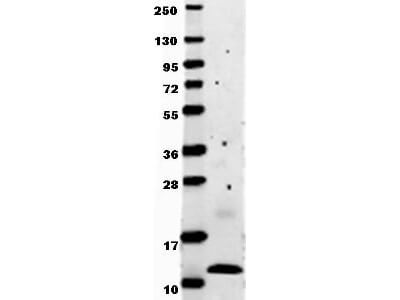
209-401-B60
MCP-1 Antibody

Eine Lieferung in diese Region ist nicht möglich.
- SKU:
- 209-401-B60
- Zusätzliche Namen:
- CCL2|rabbit anti-MCP-1 Antibody, CCL2, C-C motif chemokine 2, Monocyte Chemotactic and Activating Factor, MCAF, Small-inducible cytokine A2, SCYA2, Monocyte chemotactic protein 1, Monocyte secretory protein JE, HC11
- Anwendung:
- ELISA, WB
- Konzentration:
- 1 mg/ml
- Physischer Zustand:
- Lyophilized
- Spezies-Reaktivität:
- Human
- Lagerbedingungen:
- 2-8[o]C liquid. Aliquot. Avoid freeze/thaw cycles., -20[o]C/-70[o]C aliquoted. Aliquot. Avoid freeze/thaw cycles.
- Hersteller:
- Rockland Inc
- Host:
- Rabbit
- Reaktivitäten:
- Human
- Buffer:
- 0.02 M Potassium Phosphate, 0.15 M Sodium Chloride
- Immunogen:
- This IgG fraction antibody was prepared from rabbit antiserum after repeated immunizations with mature length recombinant human MCP-1 protein produced in E.coli.
- Formulierung:
- 0.02 M Potassium Phosphate, 0.15 M Sodium Chloride, pH 7.2
- Uniprot:
- P13500
- Synonyme:
- C-C motif chemokine 2;chemokine (C-C motif) ligand 2;GDCF-2;HC11;HSMCR30;MCAF;MCP-1;MCP1;Monocyte chemoattractant protein 1;monocyte chemoattractant protein-1;monocyte chemotactic and activating factor;monocyte chemotactic protein 1;monocyte secretory protein JE;SCYA2;small inducible cytokine A2 (monocyte chemotactic protein 1, homologous to mouse Sig-je);small inducible cytokine subfamily A (Cys-Cys), member 2;small-inducible cytokine A2;SMC-CF
- Weitere Details:
- MCP-1, or Monocyte chemoattractant protein 1, of the intercrine beta (chemokine CC) family, is a chemotactic factor that attracts monocytes and basophils but not neutrophils or eosinophils. It augments monocyte anti-tumor activity and has been implicated in the pathogenesis of diseases characterized by monocytic infiltrates, like psoriasis, rheumatoid arthritis or atherosclerosis. It may be involved in the recruitment of monocytes into the arterial wall during the disease process of atherosclerosis. MCP-1 exists as a monomer or homodimer; in equilibrium. It binds to CCR2 and CCR4 and is tethered on endothelial cells by glycosaminoglycan (GAG) side chains of proteoglycans. Processing at the N-terminus can regulate receptor and target cell selectivity. Deletion of the N-terminal residue converts it from an activator of basophil to an eosinophil chemoattractant.
- Versandbedingungen:
- Ambient