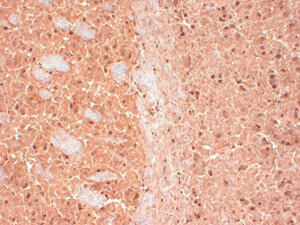
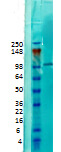
200-301-F02
CASK Antibody

Eine Lieferung in diese Region ist nicht möglich.
- SKU:
- 200-301-F02
- Zusätzliche Namen:
- Cask|Peripheral plasma membrane protein CASK, Calcium/calmodulin-dependent serine protein kinase
- Anwendung:
- IHC, WB, IP
- Konzentration:
- 1 mg/ml
- Physischer Zustand:
- Liquid
- Spezies-Reaktivität:
- Rat
- Lagerbedingungen:
- -20[o]C aliquoted. Aliquot. Avoid freeze/thaw cycles., 2-8[o]C diluted. Aliquot. Avoid freeze/thaw cycles.
- Hersteller:
- Rockland Inc
- Host:
- Mouse
- Reaktivitäten:
- Fish, Human, Mouse, Rat
- Buffer:
- 0.02 M Potassium Phosphate, 0.15 M Sodium Chloride
- Immunogen:
- CASK Antibody was produced in mice by repeated immunizations with a fusion protein of rat CASK/Lin2.
- Formulierung:
- 0.02 M Potassium Phosphate, 0.15 M Sodium Chloride, pH 7.2
- Klon:
- S56A-50
- Uniprot:
- Q62915
- Synonyme:
- Calcium/calmodulin-dependent serine protein kinase;calcium/calmodulin-dependent serine protein kinase (MAGUK family);peripheral plasma membrane protein CASK;peripheral plasma membrane protein CASK-like
- Weitere Details:
- CASK (calmodulin sensitive kinase) is a ~112kDa member of the membrane associated quanylate kinase (MAGUK) protein family. It is an adaptor protein with a calcium/calmodulin-dependent protein kinase domain, a SH3 domain, aguanylate kinase homology domain (GUK) and a PDZ domain. CASK links transmembrane proteins to the cytoskeleton and signaling molecules. In particular, CASK binds to Neurexin to stabilize pre- and post-synaptic structures. While most of CASK proteins are cytoplasmic, a portion of the protein enters the nucleus, where it acts as a transcriptional co-activator. Manifesting the importance of CASK, transgenic mice with insertional mutations die within 24 hours of births. CASK is also localized in the nuclei of basal keratinocytes in newborn rodent skin and developing hair follicles. It may play a role in wound healing.
- Versandbedingungen:
- Dry Ice