109-401-C39
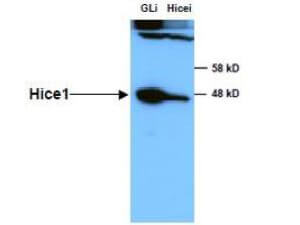
HICE1 Antibody

Eine Lieferung in diese Region ist nicht möglich.
- SKU:
- 109-401-C39
- Zusätzliche Namen:
- HAUS8|HAUS8, HAUS augmin-like complex subunit 8, HEC1/NDC80-interacting centrosome-associated protein 1, Sarcoma antigen NY-SAR-48, rabbit anti-HICE1 Antibody
- Anwendung:
- ELISA, WB
- Konzentration:
- 38 mg/ml
- Physischer Zustand:
- Liquid
- Spezies-Reaktivität:
- Human
- Lagerbedingungen:
- -20[o]C aliquoted. Aliquot. Avoid freeze/thaw cycles., 2-8[o]C diluted. Aliquot. Avoid freeze/thaw cycles.
- Hersteller:
- Rockland Inc
- Host:
- Rabbit
- Reaktivitäten:
- Human
- Buffer:
- 0.02 M Potassium Phosphate, 0.15 M Sodium Chloride
- Immunogen:
- Anti-HICE1 was prepared from whole rabbit serum produced by repeated immunizations with a recombinant full length Hice1 protein.
- Formulierung:
- 0.02 M Potassium Phosphate, 0.15 M Sodium Chloride, pH 7.2
- Format:
- Antiserum
- Uniprot:
- Q9BT25
- Synonyme:
- DGT4;HAUS augmin-like complex subunit 8;Hec1-interacting and centrosome-associated 1;HEC1/NDC80 interacting, centrosome associated 1;HEC1/NDC80-interacting centrosome-associated protein 1;HICE1;NY-SAR-48;sarcoma antigen NY-SAR-48
- Weitere Details:
- This antibody is designed, produced, and validated as part of a collaboration between Rockland and the National Cancer Institute (NCI) and is suitable for Cancer, Immunology and Nuclear Signaling research. Hice1 contributes to the mitotic spindle assembly, maintenance of centrosome integrity and completion of cytokinesis as part of the HAUS augmin-like complex. Normal bipolar spindle formation is critical for accurate chromosome segregation and proper mitotic progression. Failure in this event leads to spindle checkpoint activation and chromosome missegregation that ultimately leads to aneuploidy. Hice1 binds to microtubules directly, and promotes spindle integrity and chromosome stability. Hice1 has also shown to play an important role in targeting the gamma TuRC complex to the mitotic spindle, a step that appears to be required for spindle-mediated microtubule generation and normal chromosome segregation. The HAUS augmin-like complex's interaction with microtubules is strong during mitosis, while it is weak or absent during interphase. During interphase, it is primarily cytoplasmic, associating with centrosomes and with the mitotic spindles, preferentially at the spindle pole vicinity. During anaphase and telophase, it additionally associates with the spindle midzone and midbody, respectively. Further characterization of the function of Hice1 will likely be important for better understanding the mechanism of normal mitotic progression and high fidelity chromosome segregation.
- Versandbedingungen:
- Dry Ice