100-401-239
DRIP130 Antibody

Eine Lieferung in diese Region ist nicht möglich.
- SKU:
- 100-401-239
- Zusätzliche Namen:
- MED23|rabbit anti-DRIP130 antibody, Mediator of RNA polymerase II transcription subunit 23, MED23, Mediator complex subunit 23, Cofactor required for Sp1, transcriptional activation subunit 3, CRSP complex subunit 3, CRSP3, Transcriptional coactivator CRSP130, ARC130, DRIP130, KIAA1216, SUR2
- Anwendung:
- ELISA, WB, IP
- Konzentration:
- 85 mg/ml
- Physischer Zustand:
- Lyophilized
- Spezies-Reaktivität:
- Human
- Lagerbedingungen:
- 2-8[o]C liquid. Aliquot. Avoid freeze/thaw cycles., -20[o]C/-70[o]C aliquoted. Aliquot. Avoid freeze/thaw cycles.
- Hersteller:
- Rockland Inc
- Host:
- Rabbit
- Reaktivitäten:
- Human, Mouse
- Buffer:
- 0.02 M Potassium Phosphate, 0.15 M Sodium Chloride
- Immunogen:
- This whole rabbit serum was prepared by repeated immunizations with a synthetic peptide corresponding to mouse DRIP-130 residues 897-916 (based on human DRIP-130 residue numbering) crosslinked to KLH.
- Formulierung:
- 0.02 M Potassium Phosphate, 0.15 M Sodium Chloride, pH 7.2
- Format:
- Antiserum
- Uniprot:
- Q9ULK4
- Synonyme:
- 130 kDa transcriptional co-activator;133 kDa transcriptional co-activator;activator-recruited cofactor 130 kDa component;ARC130;cofactor required for Sp1 transcriptional activation subunit 3;CRSP130;CRSP133;CRSP3;DRIP130;Mediator complex subunit 23;mediator of RNA polymerase II transcription subunit 23;mental retardation, non-syndromic, autosomal recessive, 18;MRT18;Protein sur-2 homolog;SUR-2;SUR2;Transcriptional coactivator CRSP130;vitamin D3 receptor interacting protein;Vitamin D3 receptor-interacting protein complex 130 kDa component
- Weitere Details:
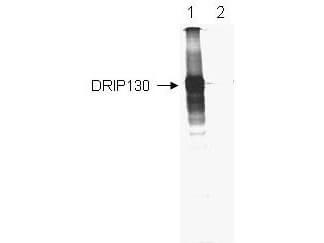
- This antiserum recognizes mouse DRIP-130 (vitamin-D-receptor interacting protein 130), and was tested for use in immunoprecipitation and immunoblotting. DRIP-130 has been described elsewhere as Sur2; CRSP130, ARC130, NAT140, and TRAP150b. DRIP-130 is component of a multi-protein complex termed DRIP that interacts with the vitamin D receptor (VDR); together, the DRIP proteins constitute a new cofactor complex. DRIP binds to several nuclear receptors and mediates ligand-dependent enhancement of transcription by VDR and the thyroid-hormone receptor in cell-free transcription assays. The DRIPs are almost indistinguishable from components of two other cofactor complexes called ARC and TRAP, which are recruited by other types of transcription activators to mediate transactivation on chromatin-assembled templates. Several DRIP/ARC/TRAP subunits are also components of other potentially related cofactors, such as CRSP, NAT, SMCC and the mouse Mediator, indicating that unique classes of activators may share common sets or subsets of cofactors. The role of nuclear-receptor ligands may, in part, be to recruit such a cofactor complex to the receptor and, in doing so, to enhance transcription of target genes. In humans, interaction with Sur-2 is required for transcription to be activated by the activation domain of a transcription factor of the ETS-family in response to activated mitogen-activated protein (MAP) kinase.
- Versandbedingungen:
- Ambient