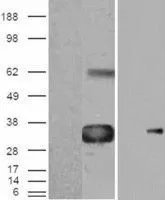
GTX88924
WISP1 antibody, C-term

Eine Lieferung in diese Region ist nicht möglich.
- SKU:
- GTX88924
- Zusätzliche Namen:
- cellular communication network factor 4 , WISP1 , WISP1-OT1 , WISP1-UT1 , WISP1c , WISP1i , WISP1tc
- Anwendung:
- WB
- Konzentration:
- 0.50 mg/ml
- Physischer Zustand:
- Liquid
- Spezies-Reaktivität:
- Human
- Aufreinigung:
- Ammonium Sulfate Precipitated; Affinity Purified
- Lagerbedingungen:
- -20[o]C Aliquot. Avoid freeze/thaw cycles. Store undiluted., 2-8[o]C Aliquot. Avoid freeze/thaw cycles. Store undiluted., -20[o]C/-70[o]C Aliquot. Avoid freeze/thaw cycles. Store undiluted.
- Hersteller:
- Genetex
- Host:
- Goat
- Reaktivitäten:
- Human
- Buffer:
- TBS, 0.5% BSA, 0.02% Sodium azide.
- Immunogen:
- Peptide with sequence C-ESYPDFSEIAN, from the C Terminus of the protein sequence according to NP_003873.1; NP_543028.1.
- Uniprot:
- O95388
- Synonyme:
- CCN family member 4;WISP1;WISP1 3'UTR-associated RNA 1;WISP1 overlapping transcript 1 (non-protein coding);WISP1-OT1;WISP1-UT1;WISP1c;WISP1i;WISP1tc;Wnt-1-induced secreted protein;WNT1 induced secreted protein 1;WNT1 inducible signaling pathway protein 1
- Weitere Details:
- This gene encodes a member of the WNT1 inducible signaling pathway (WISP) protein subfamily, which belongs to the connective tissue growth factor (CTGF) family. WNT1 is a member of a family of cysteine-rich, glycosylated signaling proteins that mediate diverse developmental processes. The CTGF family members are characterized by four conserved cysteine-rich domains: insulin-like growth factor-binding domain, von Willebrand factor type C module, thrombospondin domain and C-terminal cystine knot-like domain. This gene may be downstream in the WNT1 signaling pathway that is relevant to malignant transformation. It is expressed at a high level in fibroblast cells, and overexpressed in colon tumors. The encoded protein binds to decorin and biglycan, two members of a family of small leucine-rich proteoglycans present in the extracellular matrix of connective tissue, and possibly prevents the inhibitory activity of decorin and biglycan in tumor cell proliferation. It also attenuates p53-mediated apoptosis in response to DNA damage through activation of the Akt kinase. It is 83% identical to the mouse protein at the amino acid level. Multiple alternatively spliced transcript variants have been identified. [provided by RefSeq, Mar 2011]
- Versandbedingungen:
- Blue Ice