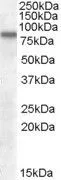
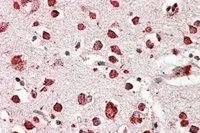
GTX88440
LIMP II antibody, Internal

Eine Lieferung in diese Region ist nicht möglich.
- SKU:
- GTX88440
- Zusätzliche Namen:
- scavenger receptor class B member 2 , AMRF , CD36L2 , EPM4 , HLGP85 , LGP85 , LIMP-2 , LIMPII , SR-BII
- Anwendung:
- WB, IHC-P
- Konzentration:
- 0.50 mg/ml
- Physischer Zustand:
- Liquid
- Spezies-Reaktivität:
- Human
- Aufreinigung:
- Ammonium Sulfate Precipitated; Affinity Purified
- Lagerbedingungen:
- -20[o]C Aliquot. Avoid freeze/thaw cycles. Store undiluted., 2-8[o]C Aliquot. Avoid freeze/thaw cycles. Store undiluted., -20[o]C/-70[o]C Aliquot. Avoid freeze/thaw cycles. Store undiluted.
- Hersteller:
- Genetex
- Host:
- Goat
- Reaktivitäten:
- Human
- Buffer:
- TBS, 0.5% BSA, 0.02% Sodium azide.
- Immunogen:
- Peptide with sequence C-NKANIQFGDNGTTIS, from the internal region of the protein sequence according to NP_005497.1.
- Uniprot:
- Q14108
- Synonyme:
- 85 kDa lysosomal membrane sialoglycoprotein;85 kDa lysosomal sialoglycoprotein scavenger receptor class B, member 2;AMRF;CD36 antigen (collagen type I receptor, thrombospondin receptor)-like 2 (lysosomal integral membrane protein II);CD36 antigen-like 2;CD36L2;EPM4;HLGP85;LGP85;LIMP II;LIMP-2;LIMPII;lysosome membrane protein 2;lysosome membrane protein II;Scavenger receptor class B member 2;SR-BII
- Weitere Details:
- The protein encoded by this gene is a type III glycoprotein that is located primarily in limiting membranes of lysosomes and endosomes. Earlier studies in mice and rat suggested that this protein may participate in membrane transportation and the reorganization of endosomal/lysosomal compartment. The protein deficiency in mice was reported to impair cell membrane transport processes and cause pelvic junction obstruction, deafness, and peripheral neuropathy. Further studies in human showed that this protein is a ubiquitously expressed protein and that it is involved in the pathogenesis of HFMD (hand, foot, and mouth disease) caused by enterovirus-71 and possibly by coxsackievirus A16. Mutations in this gene caused an autosomal recessive progressive myoclonic epilepsy-4 (EPM4), also known as action myoclonus-renal failure syndrome (AMRF). Alternatively spliced transcript variants encoding different isoforms have been found for this gene.[provided by RefSeq, Feb 2011]
- Versandbedingungen:
- Blue Ice