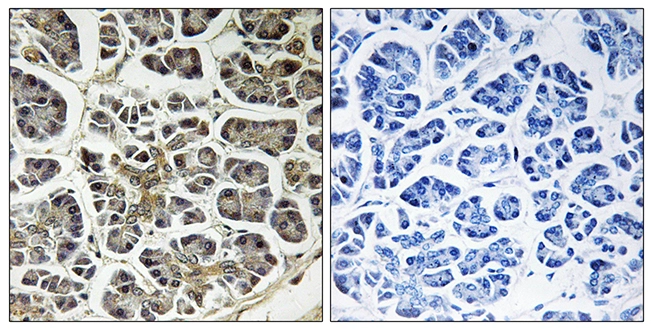
GTX87662
ATP5G2 antibody

Eine Lieferung in diese Region ist nicht möglich.
- SKU:
- GTX87662
- Zusätzliche Namen:
- ATP synthase, H+ transporting, mitochondrial Fo complex subunit C2 (subunit 9) , ATP5A , ATP5G2 , ATP synthase membrane subunit c locus 2
- Anwendung:
- IHC-P
- Physischer Zustand:
- Liquid
- Spezies-Reaktivität:
- Human
- Aufreinigung:
- Affinity Purified
- Lagerbedingungen:
- -20[o]C Aliquot. Avoid freeze/thaw cycles. Store undiluted., 2-8[o]C Aliquot. Avoid freeze/thaw cycles. Store undiluted., -20[o]C/-70[o]C Aliquot. Avoid freeze/thaw cycles. Store undiluted.
- Hersteller:
- Genetex
- Host:
- Rabbit
- Reaktivitäten:
- Human
- Buffer:
- PBS, 150mM NaCl, 50% Glycerol, 0.02% Sodium azide.
- Immunogen:
- The antiserum was produced against synthesized peptide derived from human ATP5G2 (1-50).
- Uniprot:
- Q06055
- Synonyme:
- ATP synthase c subunit;ATP synthase F(0) complex subunit C2, mitochondrial;ATP synthase lipid-binding protein;ATP synthase lipid-binding protein, mitochondrial;ATP synthase membrane subunit c locus 2;ATP synthase proteolipid P2;ATP synthase proton-transporting mitochondrial F(0) complex subunit C2;ATP synthase, H+ transporting, mitochondrial F0 complex, subunit C2 (subunit 9);ATP synthase, H+ transporting, mitochondrial Fo complex subunit C2 (subunit 9);ATP5A;ATP5G2;ATPase protein 9;ATPase subunit C;dicyclohexylcarbodiimide (DCCD)-reactive proteolipid subunit
- Weitere Details:
- This gene encodes a subunit of mitochondrial ATP synthase. Mitochondrial ATP synthase catalyzes ATP synthesis, utilizing an electrochemical gradient of protons across the inner membrane during oxidative phosphorylation. ATP synthase is composed of two linked multi-subunit complexes: the soluble catalytic core, F1, and the membrane-spanning component, Fo, comprising the proton channel. The catalytic portion of mitochondrial ATP synthase consists of 5 different subunits (alpha, beta, gamma, delta, and epsilon) assembled with a stoichiometry of 3 alpha, 3 beta, and single representatives of the gamma, delta, and epsilon subunits. The proton channel likely has nine subunits (a, b, c, d, e, f, g, F6 and 8). There are three separate genes which encode subunit c of the proton channel and they specify precursors with different import sequences but identical mature proteins. The protein encoded by this gene is one of three precursors of subunit c. This gene has multiple pseudogenes. [provided by RefSeq, Jan 2018]
- Versandbedingungen:
- Blue Ice