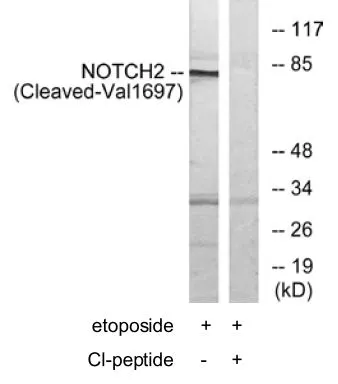
GTX86911
NOTCH2 (cleaved Val1697) antibody

Eine Lieferung in diese Region ist nicht möglich.
- SKU:
- GTX86911
- Zusätzliche Namen:
- AGS2,HJCYS,NOTCH2,hN2,notch 2,Notch 2,notch receptor 2
- Anwendung:
- WB
- Physischer Zustand:
- Liquid
- Spezies-Reaktivität:
- Human
- Aufreinigung:
- Affinity Purified
- Lagerbedingungen:
- -20[o]C Aliquot. Avoid freeze/thaw cycles. Store undiluted., 2-8[o]C Aliquot. Avoid freeze/thaw cycles. Store undiluted., -20[o]C/-70[o]C Aliquot. Avoid freeze/thaw cycles. Store undiluted.
- Hersteller:
- Genetex
- Host:
- Rabbit
- Reaktivitäten:
- Human
- Buffer:
- PBS, 150mM NaCl, 0.5% BSA, 50% glycerol (Please contact us for BSA-free format), 0.02% Sodium azide.
- Immunogen:
- The antiserum was produced against synthesized peptide derived from human NOTCH2.
- Uniprot:
- Q04721
- Synonyme:
- AGS2;HJCYS;hN2;neurogenic locus notch homolog protein 2;notch 2;Notch homolog 2
- Weitere Details:
- This gene encodes a member of the Notch family. Members of this Type 1 transmembrane protein family share structural characteristics including an extracellular domain consisting of multiple epidermal growth factor-like (EGF) repeats, and an intracellular domain consisting of multiple, different domain types. Notch family members play a role in a variety of developmental processes by controlling cell fate decisions. The Notch signaling network is an evolutionarily conserved intercellular signaling pathway which regulates interactions between physically adjacent cells. In Drosophilia, notch interaction with its cell-bound ligands (delta, serrate) establishes an intercellular signaling pathway that plays a key role in development. Homologues of the notch-ligands have also been identified in human, but precise interactions between these ligands and the human notch homologues remain to be determined. This protein is cleaved in the trans-Golgi network, and presented on the cell surface as a heterodimer. This protein functions as a receptor for membrane bound ligands, and may play a role in vascular, renal and hepatic development. Two transcript variants encoding different isoforms have been found for this gene. [provided by RefSeq, Jan 2011]
- Versandbedingungen:
- Blue Ice