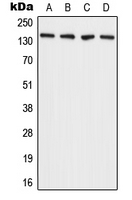
GTX54941
ADAMTS2 antibody

Eine Lieferung in diese Region ist nicht möglich.
- SKU:
- GTX54941
- Zusätzliche Namen:
- ADAM metallopeptidase with thrombospondin type 1 motif 2 , ADAM-TS2 , ADAMTS-2 , ADAMTS-3 , EDSDERMS , NPI , PC I-NP , PCI-NP , PCINP , PCPNI , PNPI
- Anwendung:
- WB
- Physischer Zustand:
- Liquid
- Spezies-Reaktivität:
- Human
- Aufreinigung:
- Affinity Purified
- Lagerbedingungen:
- -20[o]C Aliquot. Avoid freeze/thaw cycles. Store undiluted., 2-8[o]C Aliquot. Avoid freeze/thaw cycles. Store undiluted., -20[o]C/-70[o]C Aliquot. Avoid freeze/thaw cycles. Store undiluted.
- Hersteller:
- Genetex
- Host:
- Rabbit
- Reaktivitäten:
- Human, Mouse, Rat
- Buffer:
- 0.42% Potassium Phosphate, 0.87% NaCl, 30% Glycerol, 0.01% Sodium azide.
- Immunogen:
- KLH-conjugated synthetic peptide encompassing a sequence within the C-term region of ADAMTS2. The exact sequence is proprietary.
- Uniprot:
- O95450
- Synonyme:
- A disintegrin and metalloproteinase with thrombospondin motifs 2;a disintegrin-like and metalloprotease (reprolysin type) with thrombospondin type 1 motif, 2;ADAM-TS2;ADAMTS-2;ADAMTS-3;EDSDERMS;NPI;PC I-NP;PCI-NP;PCINP;PCPNI;PNPI;procollagen I N-proteinase;procollagen I/II amino propeptide-processing enzyme;procollagen N-endopeptidase
- Weitere Details:
- This gene encodes a member of the ADAMTS (a disintegrin and metalloproteinase with thrombospondin motifs) protein family. Members of the family share several distinct protein modules, including a propeptide region, a metalloproteinase domain, a disintegrin-like domain, and a thrombospondin type 1 (TS) motif. Individual members of this family differ in the number of C-terminal TS motifs, and some have unique C-terminal domains. The encoded preproprotein is proteolytically processed to generate the mature procollagen N-proteinase. This proteinase excises the N-propeptide of the fibrillar procollagens types I-III and type V. Mutations in this gene cause Ehlers-Danlos syndrome type VIIC, a recessively inherited connective-tissue disorder. Alternative splicing results in multiple transcript variants, at least one of which encodes an isoform that is proteolytically processed. [provided by RefSeq, Feb 2016]
- Versandbedingungen:
- Blue Ice