GTX54888
AKAP13 antibody

Eine Lieferung in diese Region ist nicht möglich.
- SKU:
- GTX54888
- Zusätzliche Namen:
- A-kinase anchoring protein 13 , AKAP-13 , AKAP-Lbc , ARHGEF13 , BRX , HA-3 , Ht31 , LBC , PRKA13 , PROTO-LB , PROTO-LBC , c-lbc , p47
- Anwendung:
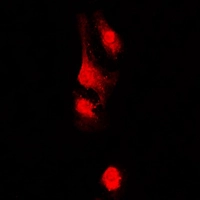
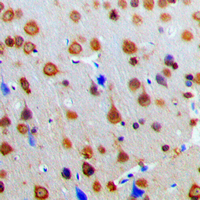
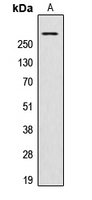
- WB, IHC-P, IF, ICC
- Physischer Zustand:
- Liquid
- Spezies-Reaktivität:
- Human
- Aufreinigung:
- Affinity Purified
- Lagerbedingungen:
- -20[o]C Aliquot. Avoid freeze/thaw cycles. Store undiluted., 2-8[o]C Aliquot. Avoid freeze/thaw cycles. Store undiluted., -20[o]C/-70[o]C Aliquot. Avoid freeze/thaw cycles. Store undiluted.
- Hersteller:
- Genetex
- Host:
- Rabbit
- Reaktivitäten:
- Human
- Buffer:
- 0.42% Potassium Phosphate, 0.87% NaCl, 30% Glycerol, 0.01% Sodium azide.
- Immunogen:
- KLH-conjugated synthetic peptide encompassing a sequence within the center region of AKAP13. The exact sequence is proprietary.
- Uniprot:
- Q12802
- Synonyme:
- A kinase (PRKA) anchor protein 13;A-kinase anchor protein 13;AKAP-13;AKAP-Lbc;ARHGEF13;breast cancer nuclear receptor-binding auxiliary protein;BRX;c-lbc;guanine nucleotide exchange factor Lbc;HA-3;Ht31;human thyroid-anchoring protein 31;LBC;LBC oncogene;lymphoid blast crisis oncogene;non-oncogenic Rho GTPase-specific GTP exchange factor;p47;PRKA13;protein kinase A-anchoring protein 13;PROTO-LB;PROTO-LBC
- Weitere Details:
- The A-kinase anchor proteins (AKAPs) are a group of structurally diverse proteins which have the common function of binding to the regulatory subunit of protein kinase A (PKA) and confining the holoenzyme to discrete locations within the cell. This gene encodes a member of the AKAP family. Alternative splicing of this gene results in multiple transcript variants encoding different isoforms containing c-terminal dbl oncogene homology (DH) and pleckstrin homology (PH) domains. The DH domain is associated with guanine nucleotide exchange activation for the Rho/Rac family of small GTP binding proteins, resulting in the conversion of the inactive GTPase to the active form capable of transducing signals. The PH domain has multiple functions. Therefore, these isoforms function as scaffolding proteins to coordinate a Rho signaling pathway, function as protein kinase A-anchoring proteins and, in addition, enhance ligand-dependent activity of estrogen receptors alpha and beta. [provided by RefSeq, Jul 2012]
- Versandbedingungen:
- Blue Ice