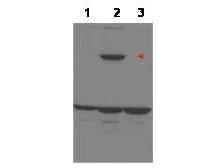
GTX48719
ASPP1 antibody

Eine Lieferung in diese Region ist nicht möglich.
- SKU:
- GTX48719
- Zusätzliche Namen:
- protein phosphatase 1 regulatory subunit 13B , ASPP1 , p53BP2-like , p85
- Anwendung:
- ELISA, WB
- Konzentration:
- 0.33 mg/ml
- Physischer Zustand:
- Liquid
- Spezies-Reaktivität:
- Human
- Aufreinigung:
- Affinity Purified
- Lagerbedingungen:
- -20[o]C Aliquot. Avoid freeze/thaw cycles. Store undiluted., 2-8[o]C Aliquot. Avoid freeze/thaw cycles. Store undiluted., -20[o]C/-70[o]C Aliquot. Avoid freeze/thaw cycles. Store undiluted.
- Hersteller:
- Genetex
- Host:
- Rabbit
- Reaktivitäten:
- Human
- Buffer:
- 20mM Potassium Phosphate, 150mM NaCl, 0.01% Sodium azide.
- Immunogen:
- Synthetic peptide corresponding to an internal sequence of human ASPP1.
- Uniprot:
- Q96KQ4
- Synonyme:
- apoptosis-stimulating of p53 protein 1;apoptosis-stimulating protein of p53, 1;ASPP1;p53BP2-like;p85;Protein phosphatase 1 regulatory subunit 13B;protein phosphatase 1, regulatory (inhibitor) subunit 13B
- Weitere Details:
- ASPP (ankyrin-repeat-, SH3-domain- proline-rich-region protein) proteins (ASPP1, ASPP2 and iASPP) represent a new family of p53 binding proteins. ASPP1 and ASPP2 bind and enhance p53-mediated apoptosis. In contrast, iASPP functionally inactivates p53. ASPPs may also regulate p63- and p73-mediated apoptosis. Both ASPP1 and 2 directly interact with p53 and specifically enhance the apoptotic function of p53 by stimulating its DNA binding and transactivation function on promoters of pro-apoptotic genes, such as Bax and PIG-3. Not all cell cycle arrest genes are affected, such as p21. Interestingly, expression of ASPP is frequently down-regulated in human breast carcinomas expressing wild-type p53 but not mutant p53. Therefore, ASPP might regulate the tumor suppression function of p53 in vivo.
- Versandbedingungen:
- Blue Ice