GTX48650
ATM (phospho Ser1981) antibody

Eine Lieferung in diese Region ist nicht möglich.
- SKU:
- GTX48650
- Zusätzliche Namen:
- ATM serine/threonine kinase , AT1 , ATA , ATC , ATD , ATDC , ATE , TEL1 , TELO1
- Anwendung:
- ELISA, WB
- Konzentration:
- 1 mg/ml
- Physischer Zustand:
- Liquid
- Spezies-Reaktivität:
- Human
- Aufreinigung:
- Affinity Purified
- Lagerbedingungen:
- -20[o]C Aliquot. Avoid freeze/thaw cycles. Store undiluted., 2-8[o]C Aliquot. Avoid freeze/thaw cycles. Store undiluted., -20[o]C/-70[o]C Aliquot. Avoid freeze/thaw cycles. Store undiluted.
- Hersteller:
- Genetex
- Host:
- Sheep
- Reaktivitäten:
- Human
- Buffer:
- 20mM Potassium Phosphate, 150mM NaCl, 0.01% Sodium azide.
- Immunogen:
- Synthetic peptide corresponding to a region near serine 1981 of human ATM conjugated to KLH using maleimide.
- Uniprot:
- Q13315
- Synonyme:
- A-T mutated;AT mutated;AT1;ATA;ataxia telangiectasia mutated;ATC;ATD;ATDC;ATE;serine-protein kinase ATM;TEL1;TEL1, telomere maintenance 1, homolog;TELO1
- Weitere Details:
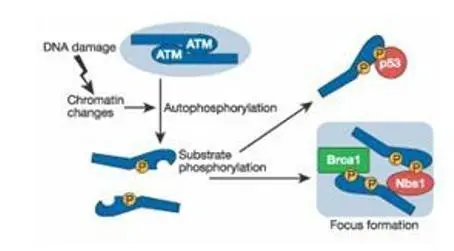
- ATM, the gene mutated in the hereditary disease ataxia-telangiectasia, codes for a protein kinase that acts as a master regulator of cellular responses to DNA double-strand breaks. ATM is normally inactive and the question of how it is activated in the event of DNA damage (due to ionizing radiation for instance) is central to understanding its function. ATM protein is now shown to be present in undamaged cells as an inactive dimer. Low doses of ionizing radiation, which induce only a few DNA breaks, activate at least half of the total ATM protein present, possibly in response to changes in chromatin structure. The ATM gene encodes a 370-kDa protein that belongs to the phosphoinositide 3-kinase (PI(3)K) superfamily, but which phosphorylates proteins rather than lipids. The 350-amino-acid kinase domain at the carboxy terminus of this large protein is the only segment of ATM with an assigned function. Exposure of cells to IR triggers ATM kinase activity and this function is required for arrests in G1, S and G2 phases of the cell cycle. Several substrates of the ATM kinase participate in these IR-induced cell-cycle arrests. These include p53, Mdm2 and Chk2 in the G1 checkpoint; Nbs1, Brca1, FancD2 and SMC1 in the transient IR-induced S-phase arrest; and Brca1 and hRad17 in the G2/M checkpoint. This antibody is similar to the rabbit host antibody discussed by Bakkenist, C. J. & Kastan, M. B. in Nature 421, 499-506 (2003).
- Versandbedingungen:
- Blue Ice