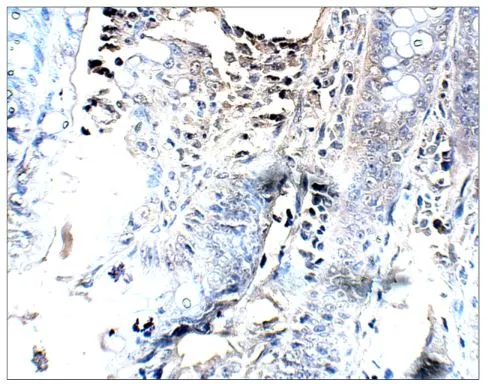
GTX47870
PGAP3 antibody (Internal)

Eine Lieferung in diese Region ist nicht möglich.
- SKU:
- GTX47870
- Zusätzliche Namen:
- post-GPI attachment to proteins 3 , AGLA546 , CAB2 , PERLD1 , PP1498 , hCOS16
- Anwendung:
- ELISA, WB, IHC-P, IP
- Konzentration:
- 0.50-0.75 mg/ml
- Physischer Zustand:
- Liquid
- Spezies-Reaktivität:
- Human
- Aufreinigung:
- Affinity Purified
- Lagerbedingungen:
- -20[o]C Aliquot. Avoid freeze/thaw cycles. Store undiluted., 2-8[o]C Aliquot. Avoid freeze/thaw cycles. Store undiluted., -20[o]C/-70[o]C Aliquot. Avoid freeze/thaw cycles. Store undiluted.
- Hersteller:
- Genetex
- Host:
- Rabbit
- Reaktivitäten:
- Human
- Buffer:
- Tris/Glycine, 0.5% BSA, 30% Glycerol, 0.02% Sodium azide.
- Immunogen:
- Synthetic peptide taken within amino acid region 10-60 on human PGAP3 protein.
- Uniprot:
- Q96FM1
- Synonyme:
- AGLA546;CAB2;COS16 homolog;gene coamplified with ERBB2 protein;hCOS16;per1-like domain containing 1;PER1-like domain-containing protein 1;PERLD1;post-GPI attachment to proteins 3;post-GPI attachment to proteins factor 3;PP1498
- Weitere Details:
- This gene encodes a glycosylphosphatidylinositol (GPI)-specific phospholipase that primarily localizes to the Golgi apparatus. This ubiquitously expressed gene is predicted to encode a seven-transmembrane protein that removes unsaturated fatty acids from the sn-2 position of GPI. The remodeling of the constituent fatty acids on GPI is thought to be important for the proper association between GPI-anchored proteins and lipid rafts. The tethering of proteins to plasma membranes via posttranslational GPI-anchoring is thought to play a role in protein sorting and trafficking. Mutations in this gene cause an autosomal recessive form of neurologic hyperphosphatasia with cognitive disability (HPMRS4). Alternative splicing results in multiple transcript variants encoding distinct isoforms. [provided by RefSeq, Jul 2017]
- Versandbedingungen:
- Blue Ice