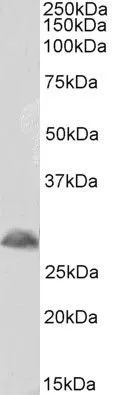
GTX47596
TREM2 antibody, Internal

Eine Lieferung in diese Region ist nicht möglich.
- SKU:
- GTX47596
- Zusätzliche Namen:
- triggering receptor expressed on myeloid cells 2 , TREM-2 , Trem2a , Trem2b , Trem2c
- Anwendung:
- WB
- Konzentration:
- 0.50 mg/ml
- Physischer Zustand:
- Liquid
- Spezies-Reaktivität:
- Mouse
- Aufreinigung:
- Ammonium Sulfate Precipitated; Affinity Purified
- Lagerbedingungen:
- -20[o]C Aliquot. Avoid freeze/thaw cycles. Store undiluted., 2-8[o]C Aliquot. Avoid freeze/thaw cycles. Store undiluted., -20[o]C/-70[o]C Aliquot. Avoid freeze/thaw cycles. Store undiluted.
- Hersteller:
- Genetex
- Host:
- Goat
- Reaktivitäten:
- Mouse
- Buffer:
- TBS, 0.5% BSA, 0.02% Sodium azide.
- Immunogen:
- Peptide with sequence C-QVEHSTSRNQET, from the internal region of the protein sequence according to NP_112544.1.
- Uniprot:
- Q99NH8
- Synonyme:
- Trem;TREM-2;Trem2a;Trem2b;Trem2c;triggering receptor expressed on monocytes 2;triggering receptor expressed on myeloid cells 2;triggering receptor expressed on myeloid cells 2a;triggering receptor expressed on myeloid cells 2b;triggering receptor expressed on myeloid cells 2c
- Weitere Details:
- The protein encoded by this gene is part of the immunoglobulin and lectin-like superfamily and functions as part of the innate immune system. This gene forms part of a cluster of genes on mouse chromosome 17 thought to be involved in innate immunity. This protein associates with the adaptor protein Dap-12 and recruits several factors, such as kinases and phospholipase C-gamma, to form a receptor signaling complex that activates myeloid cells, including dendritic cells and microglia. In humans homozygous loss-of-function mutations in this gene cause Nasu-Hakola disease and mutations in this gene may be risk factors to the development of Alzheimer's disease. In mouse mutations of this gene serve as a pathophysiological model for polycystic lipomembranous osteodysplasia with sclerosing leukoencephalopathy (Nasu-Hakola disease) and for inflammatory bowel disease. Alternative splicing results in multiple transcript variants that encode different protein isoforms. [provided by RefSeq, Jan 2013]
- Versandbedingungen:
- Blue Ice