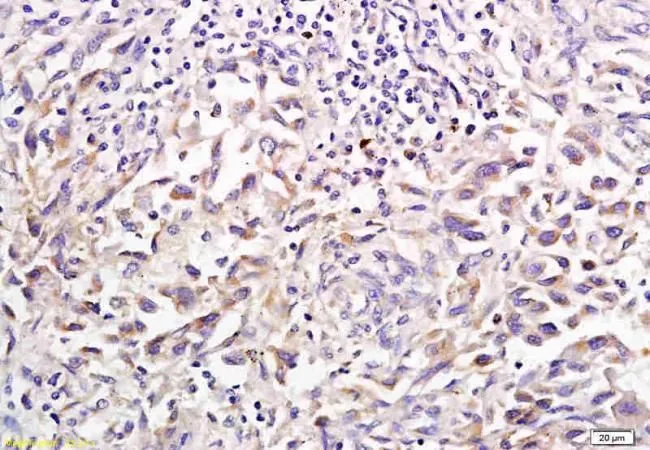
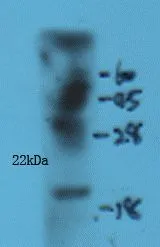
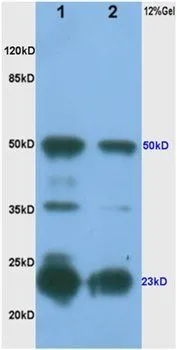
GTX37548
Shh antibody

Eine Lieferung in diese Region ist nicht möglich.
- SKU:
- GTX37548
- Zusätzliche Namen:
- sonic hedgehog signaling molecule , HHG1 , HLP3 , HPE3 , MCOPCB5 , SMMCI , ShhNC , TPT , TPTPS
- Anwendung:
- WB, IHC-P
- Konzentration:
- 0.5 mg/ml
- Physischer Zustand:
- Liquid
- Spezies-Reaktivität:
- Human
- Aufreinigung:
- Protein A Purified
- Lagerbedingungen:
- -20[o]C Aliquot. Avoid freeze/thaw cycles. Store undiluted., 2-8[o]C Aliquot. Avoid freeze/thaw cycles. Store undiluted., -20[o]C/-70[o]C Aliquot. Avoid freeze/thaw cycles. Store undiluted.
- Hersteller:
- Genetex
- Host:
- Rabbit
- Reaktivitäten:
- Human, Mouse
- Buffer:
- 10mM TBS, 0.5% BSA, 25% Glycerol, 0.015% ProClin 300.
- Immunogen:
- KLH conjugated synthetic peptide derived between 31-110 amino acids of human Sonic Hedgehog
- Uniprot:
- Q15465
- Synonyme:
- HHG-1;HHG1;HLP3;HPE3;MCOPCB5;shh unprocessed N-terminal signaling and C-terminal autoprocessing domains;ShhNC;SMMCI;sonic hedgehog homolog;sonic hedgehog protein;TPT;TPTPS
- Weitere Details:
- This gene encodes a protein that is instrumental in patterning the early embryo. It has been implicated as the key inductive signal in patterning of the ventral neural tube, the anterior-posterior limb axis, and the ventral somites. Of three human proteins showing sequence and functional similarity to the sonic hedgehog protein of Drosophila, this protein is the most similar. The protein is made as a precursor that is autocatalytically cleaved; the N-terminal portion is soluble and contains the signalling activity while the C-terminal portion is involved in precursor processing. More importantly, the C-terminal product covalently attaches a cholesterol moiety to the N-terminal product, restricting the N-terminal product to the cell surface and preventing it from freely diffusing throughout the developing embryo. Defects in this protein or in its signalling pathway are a cause of holoprosencephaly (HPE), a disorder in which the developing forebrain fails to correctly separate into right and left hemispheres. HPE is manifested by facial deformities. It is also thought that mutations in this gene or in its signalling pathway may be responsible for VACTERL syndrome, which is characterized by vertebral defects, anal atresia, tracheoesophageal fistula with esophageal atresia, radial and renal dysplasia, cardiac anomalies, and limb abnormalities. Additionally, mutations in a long range enhancer located approximately 1 megabase upstream of this gene disrupt limb patterning and can result in preaxial polydactyly. [provided by RefSeq, Jul 2008]
- Versandbedingungen:
- Blue Ice