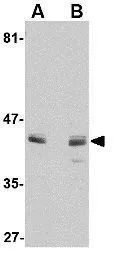
GTX31779
Activin Receptor Type IA antibody

Eine Lieferung in diese Region ist nicht möglich.
- SKU:
- GTX31779
- Zusätzliche Namen:
- activin A receptor type 1 , ACTRI , ACVR1A , ACVRLK2 , ALK2 , FOP , SKR1 , TSRI
- Anwendung:
- ELISA, WB
- Konzentration:
- 1 mg/ml
- Physischer Zustand:
- Liquid
- Spezies-Reaktivität:
- Human
- Aufreinigung:
- Affinity Purified
- Lagerbedingungen:
- -20[o]C Aliquot. Avoid freeze/thaw cycles. Store undiluted., 2-8[o]C Aliquot. Avoid freeze/thaw cycles. Store undiluted., -20[o]C/-70[o]C Aliquot. Avoid freeze/thaw cycles. Store undiluted.
- Hersteller:
- Genetex
- Host:
- Rabbit
- Reaktivitäten:
- Human, Mouse
- Buffer:
- PBS, 0.02% Sodium azide.
- Immunogen:
- Activin A Receptor type I antibody was raised against a 14 amino acid synthetic peptide near the amino terminus of the human Activin A Receptor type I.The immunogen is located within the first 50 amino acids of Activin A Receptor type I.
- Uniprot:
- Q04771
- Synonyme:
- activin A receptor, type I;activin A receptor, type II-like kinase 2;activin receptor type I;activin receptor type-1;activin receptor-like kinase 2;ACTRI;ACVR1A;ACVRLK2;ALK2;FOP;hydroxyalkyl-protein kinase;serine/threonine-protein kinase receptor R1;SKR1;TGF-B superfamily receptor type I;TSRI
- Weitere Details:
- Activins are dimeric growth and differentiation factors which belong to the transforming growth factor-beta (TGF-beta) superfamily of structurally related signaling proteins. Activins signal through a heteromeric complex of receptor serine kinases which include at least two type I ( I and IB) and two type II (II and IIB) receptors. These receptors are all transmembrane proteins, composed of a ligand-binding extracellular domain with cysteine-rich region, a transmembrane domain, and a cytoplasmic domain with predicted serine/threonine specificity. Type I receptors are essential for signaling; and type II receptors are required for binding ligands and for expression of type I receptors. Type I and II receptors form a stable complex after ligand binding, resulting in phosphorylation of type I receptors by type II receptors. This gene encodes activin A type I receptor which signals a particular transcriptional response in concert with activin type II receptors. Mutations in this gene are associated with fibrodysplasia ossificans progressive. [provided by RefSeq, Jul 2008]
- Versandbedingungen:
- Blue Ice