

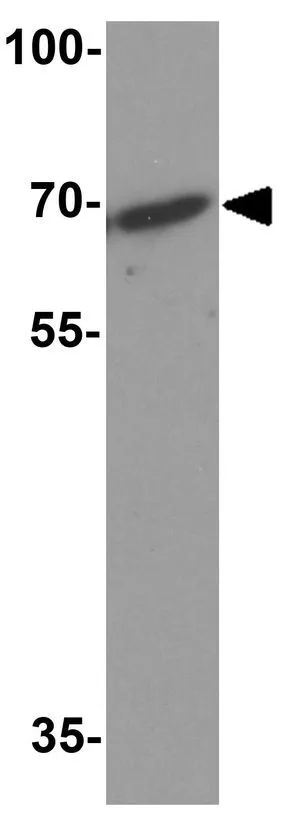
GTX31604
Wip1 antibody

Eine Lieferung in diese Region ist nicht möglich.
- SKU:
- GTX31604
- Zusätzliche Namen:
- protein phosphatase, Mg2+/Mn2+ dependent 1D , IDDGIP , PP2C-DELTA , WIP1
- Anwendung:
- ELISA, WB, IHC-P
- Konzentration:
- 1 mg/ml
- Physischer Zustand:
- Liquid
- Spezies-Reaktivität:
- Human
- Aufreinigung:
- Affinity Purified
- Lagerbedingungen:
- -20[o]C Aliquot. Avoid freeze/thaw cycles. Store undiluted., 2-8[o]C Aliquot. Avoid freeze/thaw cycles. Store undiluted., -20[o]C/-70[o]C Aliquot. Avoid freeze/thaw cycles. Store undiluted.
- Hersteller:
- Genetex
- Host:
- Rabbit
- Reaktivitäten:
- Human, Mouse, Rat
- Buffer:
- PBS, 0.02% Sodium azide.
- Immunogen:
- Wip1 antibody was raised against an 18 amino acid peptide near the carboxy terminus of human Wip1.The immunogen is located within the last 50 amino acids of Wip1.
- Uniprot:
- O15297
- Synonyme:
- IDDGIP;JDVS;p53-induced protein phosphatase 1;PP2C-DELTA;protein phosphatase 1D;Protein phosphatase 2C isoform delta;Protein phosphatase magnesium-dependent 1 delta;protein phosphatase Wip1;wild-type p53-induced phosphatase 1;WIP1
- Weitere Details:
- The protein encoded by this gene is a member of the PP2C family of Ser/Thr protein phosphatases. PP2C family members are known to be negative regulators of cell stress response pathways. The expression of this gene is induced in a p53-dependent manner in response to various environmental stresses. While being induced by tumor suppressor protein TP53/p53, this phosphatase negatively regulates the activity of p38 MAP kinase, MAPK/p38, through which it reduces the phosphorylation of p53, and in turn suppresses p53-mediated transcription and apoptosis. This phosphatase thus mediates a feedback regulation of p38-p53 signaling that contributes to growth inhibition and the suppression of stress induced apoptosis. This gene is located in a chromosomal region known to be amplified in breast cancer. The amplification of this gene has been detected in both breast cancer cell line and primary breast tumors, which suggests a role of this gene in cancer development. [provided by RefSeq, Jul 2008]
- Versandbedingungen:
- Blue Ice