GTX24753
Apg8 antibody

Eine Lieferung in diese Region ist nicht möglich.
- SKU:
- GTX24753
- Zusätzliche Namen:
- ubiquitin-like protein ATG8 , APG8 , AUT7 , CVT5
- Anwendung:
- ELISA, IHC, WB, IP
- Konzentration:
- 5 mg/ml
- Physischer Zustand:
- Liquid
- Spezies-Reaktivität:
- Yeast/Fungi
- Lagerbedingungen:
- -20[o]C Aliquot. Avoid freeze/thaw cycles. Store undiluted., 2-8[o]C Aliquot. Avoid freeze/thaw cycles. Store undiluted., -20[o]C/-70[o]C Aliquot. Avoid freeze/thaw cycles. Store undiluted.
- Hersteller:
- Genetex
- Host:
- Rabbit
- Reaktivitäten:
- Yeast
- Buffer:
- 20mM Potassium Phosphate, 150mM NaCl, 0.01% Sodium azide.
- Immunogen:
- Recombinant yeast Apg8 protein.
- Uniprot:
- P38182
- Synonyme:
- APG8;AUT7;Autophagy-related ubiquitin-like modifier ATG8;CVT5;Cytoplasm to vacuole targeting protein 5;ubiquitin-like protein ATG8;YBL078C
- Weitere Details:
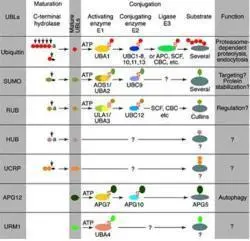
- Ubiquitin-like proteins fall into two classes: the first class, ubiquitin-like modifiers (UBLs) function as modifiers in a manner analogous to that of ubiquitin. Examples of UBLs are SUMO, Rub1 (also called Nedd8), Apg8 and Apg12. Proteins of the second class include parkin, RAD23 and DSK2, are designated ubiquitin-domain proteins (UDPs). These proteins contain domains that are related to ubiquitin but are otherwise unrelated to each other. In contrast to UBLs, UDPs are not conjugated to other proteins. Apg8 is required for autophagy (intracellular bulk protein degradation) in yeast. Starved yeast cells take up their own cytoplasm into vacuoles through autophagic bodies. Autophagic bodies form a double-membraned structure called the autophagosome, which subsequently fuses with the vacuole/lysosome. This process similar in mammals. Two sets of genes, APG and AUT, have been identified with this process, and are responsible for two ubiquitin-like systems Apg12 and Apg8, respectively. Apg12 is synthesized in its mature form and seems to have one target, Apg5. Almost all Apg12 molecules are conjugated with Apg5. Aut2/Apg4 processes the Apg8/Aut7 system at its carboxy-terminal region. Apg8 exists in two forms, one is membrane bound through a phospholipid. Lipidation/ activation of Apg8 is mediated by Apg7 and transferred to Apg3 and finally forms a conjugate with phosphatidyl-ethanolamine (PE). Apg4 cleaves Apg8 PE, releasing Apg8 from membrane. Morphological studies show that Apg8 localizes on the membrane of intermediate structures of the autophagosome; this transient association seems to be essential for formation of the autophagosome. Both Apg12 and Apg8 are highly conserved, with apparent homologues in the worm, mammals and plants. In higher eukaryotes, Apg8 consists of a multigene family.
- Versandbedingungen:
- Blue Ice