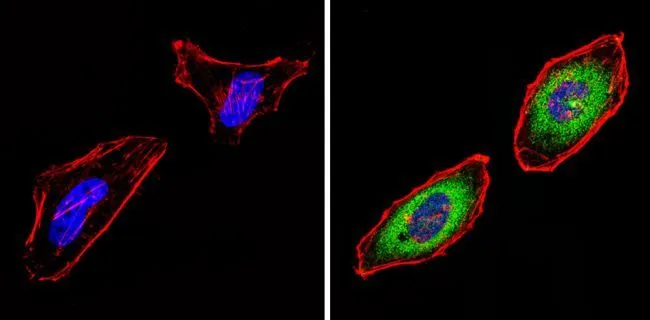
GTX23331
PSMB6 antibody

Eine Lieferung in diese Region ist nicht möglich.
- SKU:
- GTX23331
- Zusätzliche Namen:
- proteasome (prosome, macropain) subunit, beta type 6 , Lmp19 , Mpnd
- Anwendung:
- WB, IF, ICC
- Konzentration:
- 1 mg/ml
- Physischer Zustand:
- Liquid
- Spezies-Reaktivität:
- Mouse
- Aufreinigung:
- Affinity Purified
- Lagerbedingungen:
- -20[o]C Aliquot. Avoid freeze/thaw cycles. Store undiluted., 2-8[o]C Aliquot. Avoid freeze/thaw cycles. Store undiluted., -20[o]C/-70[o]C Aliquot. Avoid freeze/thaw cycles. Store undiluted.
- Hersteller:
- Genetex
- Host:
- Rabbit
- Reaktivitäten:
- Bovine, Human, Mouse
- Buffer:
- PBS, 0.1% BSA, 0.05% Sodium azide.
- Immunogen:
- Synthetic Peptides: C(41) R S G S A A D T Q A V/I A D A V T Y(58)
- Uniprot:
- Q60692
- Synonyme:
- Lmp;Lmp19;low molecular mass protein 19;macropain delta chain;Mp;Mpnd;multicatalytic endopeptidase complex delta chain;proteasome delta chain;proteasome subunit beta type-6;proteasome subunit Y;subunit 2
- Weitere Details:
- Proteolytic degradation is critical to the maintenance of appropriate levels of short-lived and regulatory proteins as important and diverse as those involved in cellular metabolism, heat shock and stress response, antigen presentation, modulation of cell surface receptors and ion channels, cell cycle regulation, transcription, and signalling factors. The ubiquitin-proteasome pathway deconstructs most proteins in the eukaryotic cell cytosol and nucleus. Other proteins are degraded via the vacuolar pathway which includes endosomes, lysosomes, and the endoplasmic reticulum. The 26S proteasome is an ATP-dependent, multisubunit (~31), barrel-shaped molecular machine with an apparent molecular weight of ~2.5 MDa. It consists of a 20S proteolytic core complex which is crowned at one or both ends by 19S regulatory subunit complexes. The 19S regulatory subunits recognize ubiquitinated proteins and play an essential role in unfolding and translocating targets into the lumen of the 20S subunit. The PA28/11S REG Activator protein complex functions as a proteolytic activator. This complex, consisting of alpha, beta, and gamma subunits, enhances the activity of the 20S proteolytic core. An enzymatic cascade is responsible for the attachment of multiple ubiquitin molecules to lysine residues of proteins targeted for degradation. Several genetic diseases are associated with defects in the ubiquitin-proteasome pathway. Some examples of affected proteins include those linked to cystic fibrosis (CF transmembrane regulator), Angelman's syndrome (E6-AP), and Liddle syndrome (endothelial sodium channels).
- Versandbedingungen:
- Blue Ice