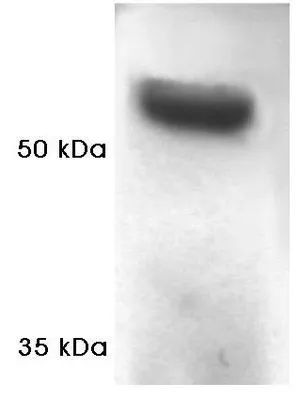
GTX23317
Proteasome 19S Subunit S4 antibody

Eine Lieferung in diese Region ist nicht möglich.
- SKU:
- GTX23317
- Zusätzliche Namen:
- proteasome 26S subunit, ATPase 1 , P26S4 , S4 , p56
- Anwendung:
- WB, IP
- Physischer Zustand:
- Liquid
- Spezies-Reaktivität:
- Human, Yeast/Fungi
- Aufreinigung:
- Ammonium Sulfate Precipitated
- Lagerbedingungen:
- -20[o]C Aliquot. Avoid freeze/thaw cycles. Store undiluted., 2-8[o]C Aliquot. Avoid freeze/thaw cycles. Store undiluted., -20[o]C/-70[o]C Aliquot. Avoid freeze/thaw cycles. Store undiluted.
- Hersteller:
- Genetex
- Host:
- Rabbit
- Reaktivitäten:
- Human
- Buffer:
- PBS, 0.1% BSA, 0.05% Sodium azide.
- Immunogen:
- Yeast proteasome 19S subunit S4.
- Uniprot:
- P62191
- Synonyme:
- 26S protease regulatory subunit 4;26S proteasome AAA-ATPase subunit RPT2;26S proteasome regulatory subunit 4;P26S4;p56;proteasome (prosome, macropain) 26S subunit, ATPase, 1;proteasome 26S ATPase subunit 1;Proteasome 26S subunit ATPase 1;RPT2;S4
- Weitere Details:
- The 26S proteasome is a multicatalytic proteinase complex with a highly ordered structure composed of 2 complexes, a 20S core and a 19S regulator. The 20S core is composed of 4 rings of 28 non-identical subunits; 2 rings are composed of 7 alpha subunits and 2 rings are composed of 7 beta subunits. The 19S regulator is composed of a base, which contains 6 ATPase subunits and 2 non-ATPase subunits, and a lid, which contains up to 10 non-ATPase subunits. Proteasomes are distributed throughout eukaryotic cells at a high concentration and cleave peptides in an ATP/ubiquitin-dependent process in a non-lysosomal pathway. An essential function of a modified proteasome, the immunoproteasome, is the processing of class I MHC peptides. This gene encodes one of the ATPase subunits, a member of the triple-A family of ATPases which have a chaperone-like activity. This subunit and a 20S core alpha subunit interact specifically with the hepatitis B virus X protein, a protein critical to viral replication. This subunit also interacts with the adenovirus E1A protein and this interaction alters the activity of the proteasome. Finally, this subunit interacts with ataxin-7, suggesting a role for the proteasome in the development of spinocerebellar ataxia type 7, a progressive neurodegenerative disorder. [provided by RefSeq, Jul 2008]
- Versandbedingungen:
- Blue Ice