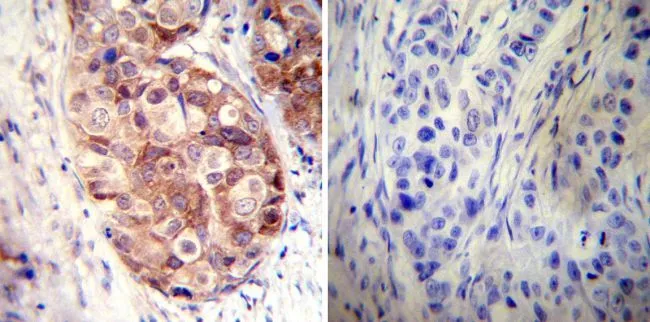
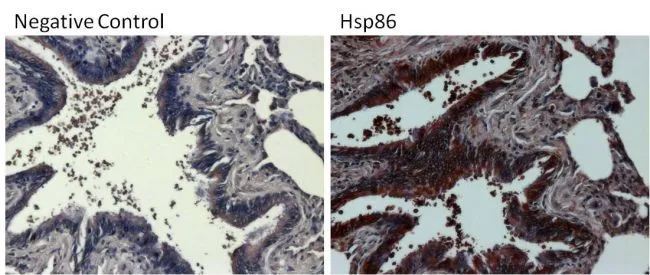
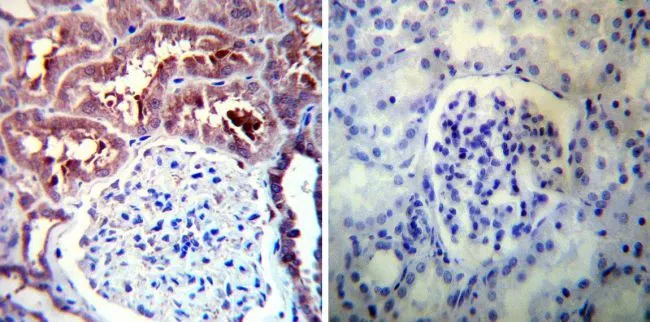
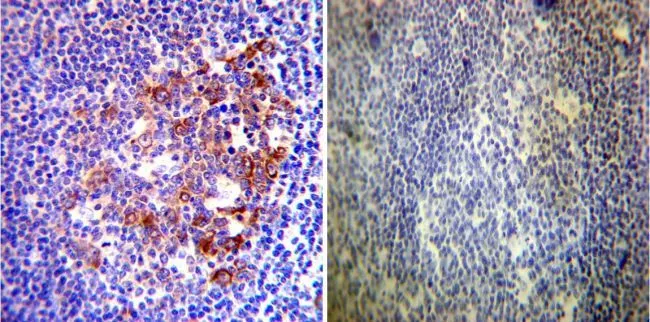
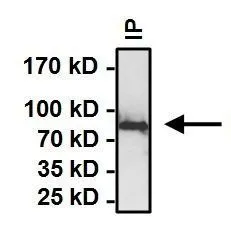
GTX22928
Hsp90 alpha antibody

Eine Lieferung in diese Region ist nicht möglich.
- SKU:
- GTX22928
- Zusätzliche Namen:
- heat shock protein 90, alpha (cytosolic), class A member 1 , 86kDa , 89kDa , AL024080 , AL024147 , Hsp86-1 , Hsp89 , Hsp90 , Hspca , hsp4
- Anwendung:
- IHC, WB, IHC-P, IF, ICC, IP
- Konzentration:
- 1 mg/ml
- Physischer Zustand:
- Liquid
- Spezies-Reaktivität:
- Mouse
- Aufreinigung:
- Affinity Purified
- Lagerbedingungen:
- -20[o]C Aliquot. Avoid freeze/thaw cycles. Store undiluted., 2-8[o]C Aliquot. Avoid freeze/thaw cycles. Store undiluted., -20[o]C/-70[o]C Aliquot. Avoid freeze/thaw cycles. Store undiluted.
- Hersteller:
- Genetex
- Host:
- Rabbit
- Reaktivitäten:
- Human, Mouse, Rabbit, Rat, Ovine
- Buffer:
- PBS, 0.1% BSA, 0.05% Sodium azide.
- Immunogen:
- Synthetic peptide corresponding to residues P(2) E E T Q T Q D Q P M(12) of mouse HSP86.
- Uniprot:
- P07901
- Synonyme:
- 86kDa;89kDa;AL024080;AL024147;heat shock 86 kDa;heat shock protein 1, alpha;heat shock protein 90kDa alpha (cytosolic), class A member 1;heat shock protein HSP 90-alpha;heat shock protein, 1;heat shock protein, 86 kDa 1;heat shock protein, 89 kDa;hs;Hsp;HSP 86;hsp4;HSP86;Hsp86-1;Hsp89;Hsp90;Hspca;TSTA;tumor-specific transplantation 86 kDa antigen
- Weitere Details:
- Heat shock proteins (HSP) are expressed in response to various biological stresses, including heat. HSP90 is a 90 kDa protein that is induced under stress conditions, but is also one of the most abundant cellular proteins found under non-stress conditions. HSP90 has been found to be associated with a number of other intracellular proteins, including steroid receptors, actin, tubulin, Ah receptor, and some kinases. Studies have shown that murine HSP90 exists as two forms, HSP84 and HSP86, coded by related but separate genes, with 86% homologous amino acid sequences. These forms are analogous to the two forms of human HSP90, HSP89 beta and HSP89 alpha. In an unstressed mouse fibroblast, the basal level of HSP84 is found to be double that of HSP86. However, after heat shock, HSP86 shows a greater increase. Studies also suggest that upon cellular differentiation, the level of HSP86, but not HSP84, decreases. HSP84 and HSP86, which may be subject to estrogenic regulation, have been found as components of the non-DNA binding form of mouse glucocorticoid receptor, but dissociated from the transformed DNA-binding form.
- Versandbedingungen:
- Blue Ice