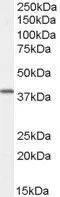
GTX22248
Dysadherin antibody

Eine Lieferung in diese Region ist nicht möglich.
- SKU:
- GTX22248
- Zusätzliche Namen:
- FXYD domain containing ion transport regulator 5 , DYSAD , HSPC113 , IWU1 , KCT1 , OIT2 , PRO6241 , RIC
- Anwendung:
- WB
- Konzentration:
- 0.50 mg/ml
- Physischer Zustand:
- Liquid
- Spezies-Reaktivität:
- Human
- Aufreinigung:
- Ammonium Sulfate Precipitated; Affinity Purified
- Lagerbedingungen:
- -20[o]C Aliquot. Avoid freeze/thaw cycles. Store undiluted., 2-8[o]C Aliquot. Avoid freeze/thaw cycles. Store undiluted., -20[o]C/-70[o]C Aliquot. Avoid freeze/thaw cycles. Store undiluted.
- Hersteller:
- Genetex
- Host:
- Goat
- Reaktivitäten:
- Human
- Buffer:
- TBS, 0.5% BSA, 0.02% Sodium azide.
- Immunogen:
- Peptide with sequence GKCRQLSRLCRNHCR, from the C Terminus of the protein sequence according to NP_054883.3; NP_659003.1; NP_001158077.1.
- Uniprot:
- Q96DB9
- Synonyme:
- DYSAD;dysadherin;FXYD domain-containing ion transport regulator 5;HSPC113;IWU1;KCT1;keratinocytes associated transmembrane protein 1;OIT2;PRO6241;RIC
- Weitere Details:
- This gene encodes a member of a family of small membrane proteins that share a 35-amino acid signature sequence domain, beginning with the sequence PFXYD and containing 7 invariant and 6 highly conserved amino acids. The approved human gene nomenclature for the family is FXYD-domain containing ion transport regulator. Mouse FXYD5 has been termed RIC (Related to Ion Channel). FXYD2, also known as the gamma subunit of the Na,K-ATPase, regulates the properties of that enzyme. FXYD1 (phospholemman), FXYD2 (gamma), FXYD3 (MAT-8), FXYD4 (CHIF), and FXYD5 (RIC) have been shown to induce channel activity in experimental expression systems. Transmembrane topology has been established for two family members (FXYD1 and FXYD2), with the N-terminus extracellular and the C-terminus on the cytoplasmic side of the membrane. This gene product, FXYD5, is a glycoprotein that functions in the up-regulation of chemokine production, and it is involved in the reduction of cell adhesion via its ability to down-regulate E-cadherin. It also promotes metastasis, and has been linked to a variety of cancers. Alternative splicing results in multiple transcript variants. [RefSeq curation by Kathleen J. Sweadner, Ph.D., [email protected]., Sep 2009]
- Versandbedingungen:
- Blue Ice