GTX21094
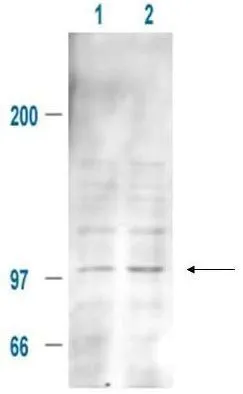
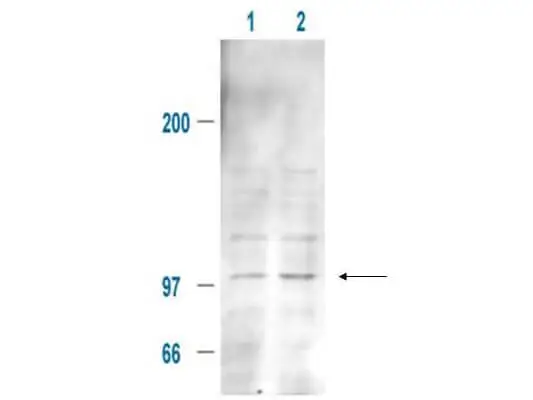
MDM2 (phospho Ser185) antibody

Eine Lieferung in diese Region ist nicht möglich.
- SKU:
- GTX21094
- Zusätzliche Namen:
- transformed mouse 3T3 cell double minute 2 , 1700007J15Rik , AA415488 , Mdm-2
- Anwendung:
- ELISA, WB, IP
- Konzentration:
- 1 mg/ml
- Physischer Zustand:
- Liquid
- Spezies-Reaktivität:
- Human, Mouse
- Aufreinigung:
- Affinity Purified
- Lagerbedingungen:
- -20[o]C Aliquot. Avoid freeze/thaw cycles. Store undiluted., 2-8[o]C Aliquot. Avoid freeze/thaw cycles. Store undiluted., -20[o]C/-70[o]C Aliquot. Avoid freeze/thaw cycles. Store undiluted.
- Hersteller:
- Genetex
- Host:
- Rabbit
- Reaktivitäten:
- Human, Mouse
- Buffer:
- 20mM Potassium Phosphate, 150mM NaCl, 0.01% Sodium azide.
- Immunogen:
- Synthetic peptide corresponding to an internal region near aa 175-200 of mouse MDM2.
- Uniprot:
- P23804
- Synonyme:
- 1700007J15Rik;AA415488;double minute 2 protein;E3 ubiquitin-protein ligase Mdm2;Mdm-2;oncoprotein Mdm2;p53-binding protein Mdm2;RING-type E3 ubiquitin transferase Mdm2
- Weitere Details:
- MDM2 is a nuclear phosphoprotein with an apparent molecular mass of 90 Kd that forms a complex with the p53 tumor suppressor protein. Human MDM2 was identified as a homologous product of the 'murine double minute 2' gene (mdm2). The MDM2 gene enhances the tumorigenic potential of cells when it is overexpressed and encodes a putative transcription factor. Forming a tight complex with the p53 gene, the MDM2 oncogene can inhibit p53-mediated transactivation. MDM2 binds to p53 and amplification of MDM2 in sarcomas leads to escape from p53-regulated growth control. This mechanism of tumorigenesis parallels that for virus-induced tumors in which viral oncogene products bind to and functionally inactivate p53. Overexpression of the MDM2 oncogene was found in leukemias. Inactivation of tumor suppressor genes leads to deregulated cell proliferation and is a key factor in human tumorigenesis. MDM2 interacts physically and functionally with the retinoblastoma (RB) protein and can inhibit its growth regulatory capacity. Both RB and p53 can be subjected to negative regulation by the product of a single cellular protooncogene. The interference of binding to p53 prevents the interaction of MDM2 and its regulation of the transcriptional activity of p53 in vivo. Direct association of p53 with the cellular protein MDM2 results in ubiquitination and subsequent degradation of p53. MDM2-p53 complexes were preferentially found in S/G2M phases of the cell cycle. MDM2 maps to 12q14.3-q15, distal to CDK4 and flanked by Genethon microsatellites D12S80 and D12S83. On both the physical and the genetic maps of chromosome 12, the IFG gene maps close to the locus of the MDM2 oncogene on 12q15. The MDM2 gene is alternatively spliced, producing 5 additional splice variant transcripts from the full length MDM2 gene. Four out of five of these alternatively spliced forms (MDM2a-MDMd) are missing substantial portions of the p53-binding domain and retain the acidic domain and the zinc-finger domains. The fifth and smallest transcript (MDM2e) retains the largest spliced region encoding the p53-binding domain; however, it lacks the nuclear localization signal, the acidic domain and zinc-finger domains. The alternatively spliced transcripts tend to be expressed in tumorigenic tissue, whereas the full length MDM2 transcript is expressed in normal tissue.
- Versandbedingungen:
- Blue Ice