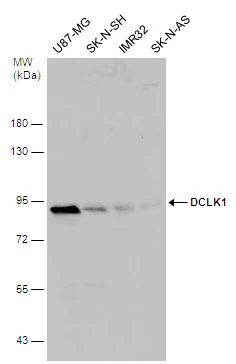
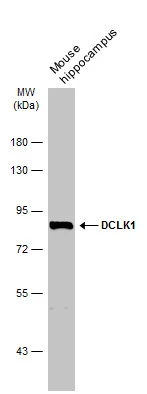
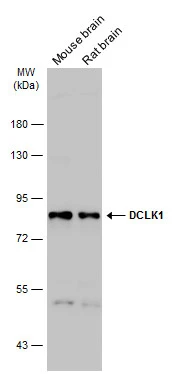
GTX130959
DCLK1 antibody

Eine Lieferung in diese Region ist nicht möglich.
- SKU:
- GTX130959
- Zusätzliche Namen:
- doublecortin like kinase 1 , CL1 , CLICK1 , DCAMKL1 , DCDC3A , DCLK
- Anwendung:
- WB
- Konzentration:
- 1.77 mg/ml
- Physischer Zustand:
- Liquid
- Spezies-Reaktivität:
- Human
- Aufreinigung:
- Affinity Purified
- Lagerbedingungen:
- -20[o]C Aliquot. Avoid freeze/thaw cycles. Store undiluted., 2-8[o]C Aliquot. Avoid freeze/thaw cycles. Store undiluted., -20[o]C/-70[o]C Aliquot. Avoid freeze/thaw cycles. Store undiluted.
- Hersteller:
- Genetex
- Host:
- Rabbit
- Reaktivitäten:
- Human, Mouse, Rat
- Buffer:
- PBS, 20% Glycerol, 0.025% ProClin 300.
- Immunogen:
- Recombinant protein encompassing a sequence within the center region of human DCLK1. The exact sequence is proprietary.
- Uniprot:
- O15075
- Synonyme:
- CL1;CLICK1;DCAMKL1;DCDC3A;DCLK;doublecortin domain-containing protein 3A;doublecortin-like and CAM kinase-like 1;Doublecortin-like kinase 1;serine/threonine-protein kinase DCLK1
- Weitere Details:
- This gene encodes a member of the protein kinase superfamily and the doublecortin family. The protein encoded by this gene contains two N-terminal doublecortin domains, which bind microtubules and regulate microtubule polymerization, a C-terminal serine/threonine protein kinase domain, which shows substantial homology to Ca2+/calmodulin-dependent protein kinase, and a serine/proline-rich domain in between the doublecortin and the protein kinase domains, which mediates multiple protein-protein interactions. The microtubule-polymerizing activity of the encoded protein is independent of its protein kinase activity. The encoded protein is involved in several different cellular processes, including neuronal migration, retrograde transport, neuronal apoptosis and neurogenesis. This gene is up-regulated by brain-derived neurotrophic factor and associated with memory and general cognitive abilities. Multiple transcript variants generated by two alternative promoter usage and alternative splicing have been reported, but the full-length nature and biological validity of some variants have not been defined. These variants encode different isoforms, which are differentially expressed and have different kinase activities.[provided by RefSeq, Sep 2010]
- Versandbedingungen:
- Blue Ice