GTX129284
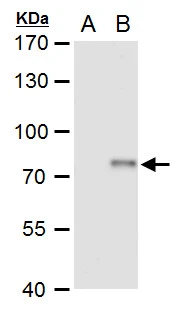
XPD antibody

Eine Lieferung in diese Region ist nicht möglich.
- SKU:
- GTX129284
- Zusätzliche Namen:
- ERCC excision repair 2, TFIIH core complex helicase subunit , COFS2 , EM9 , TFIIH , TTD , TTD1 , XPD
- Anwendung:
- WB
- Konzentration:
- 1 mg/ml
- Physischer Zustand:
- Liquid
- Spezies-Reaktivität:
- Human
- Aufreinigung:
- Affinity Purified
- Lagerbedingungen:
- -20[o]C Aliquot. Avoid freeze/thaw cycles. Store undiluted., 2-8[o]C Aliquot. Avoid freeze/thaw cycles. Store undiluted., -20[o]C/-70[o]C Aliquot. Avoid freeze/thaw cycles. Store undiluted.
- Hersteller:
- Genetex
- Host:
- Rabbit
- Reaktivitäten:
- Human
- Buffer:
- PBS, 20% Glycerol, 0.025% ProClin 300.
- Immunogen:
- Recombinant protein encompassing a sequence within the C-terminus region of human XPD. The exact sequence is proprietary.
- Uniprot:
- P18074
- Synonyme:
- basic transcription factor 2 80 kDa subunit;BTF2 p80;COFS2;CXPD;DNA excision repair protein ERCC-2;DNA repair protein complementing XP-D cells;EM9;excision repair cross-complementation group 2;excision repair cross-complementing rodent repair deficiency, complementation group 2;general transcription and DNA repair factor IIH helicase subunit XPD;TFIIH;TFIIH 80 kDa subunit;TFIIH basal transcription factor complex 80 kDa subunit;TFIIH basal transcription factor complex helicase subunit;TFIIH basal transcription factor complex helicase XPB subunit;TFIIH basal transcription factor complex helicase XPD subunit;TFIIH p80;TFIIH subunit XPD;TTD;TTD1;xeroderma pigmentosum complementary group D;xeroderma pigmentosum group D-complementing protein;XPD
- Weitere Details:
- The nucleotide excision repair pathway is a mechanism to repair damage to DNA. The protein encoded by this gene is involved in transcription-coupled nucleotide excision repair and is an integral member of the basal transcription factor BTF2/TFIIH complex. The gene product has ATP-dependent DNA helicase activity and belongs to the RAD3/XPD subfamily of helicases. Defects in this gene can result in three different disorders, the cancer-prone syndrome xeroderma pigmentosum complementation group D, trichothiodystrophy, and Cockayne syndrome. Alternatively spliced transcript variants encoding different isoforms have been found for this gene. [provided by RefSeq]
- Versandbedingungen:
- Blue Ice