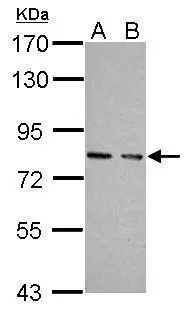
GTX111610
cGK1 antibody

Eine Lieferung in diese Region ist nicht möglich.
- SKU:
- GTX111610
- Zusätzliche Namen:
- protein kinase cGMP-dependent 1 , AAT8 , PKG , PKG1 , PRKG1B , PRKGR1B , cGK , cGK 1 , cGK1 , cGKI , cGKI-BETA , cGKI-alpha
- Anwendung:
- WB
- Konzentration:
- 1 mg/ml
- Physischer Zustand:
- Liquid
- Spezies-Reaktivität:
- Human, Mouse
- Aufreinigung:
- Affinity Purified
- Lagerbedingungen:
- -20[o]C Aliquot. Avoid freeze/thaw cycles. Store undiluted., 2-8[o]C Aliquot. Avoid freeze/thaw cycles. Store undiluted., -20[o]C/-70[o]C Aliquot. Avoid freeze/thaw cycles. Store undiluted.
- Hersteller:
- Genetex
- Host:
- Rabbit
- Reaktivitäten:
- Mouse
- Buffer:
- 0.1M Tris, 0.1M Glycine, 10% Glycerol, 0.01% Thimerosal.
- Immunogen:
- Recombinant protein encompassing a sequence within the center region of human cGK1. The exact sequence is proprietary.
- Uniprot:
- Q13976
- Synonyme:
- AAT8;cGK;cGK 1;cGK1;cGKI;cGKI-alpha;cGKI-BETA;cGMP-dependent protein kinase 1;cGMP-dependent protein kinase I;PKG;PKG1;PRKG1B;PRKGR1B;protein kinase, cGMP-dependent, regulatory, type I, beta;protein kinase, cGMP-dependent, type I
- Weitere Details:
- Mammals have three different isoforms of cyclic GMP-dependent protein kinase (Ialpha, Ibeta, and II). These PRKG isoforms act as key mediators of the nitric oxide/cGMP signaling pathway and are important components of many signal transduction processes in diverse cell types. This PRKG1 gene on human chromosome 10 encodes the soluble Ialpha and Ibeta isoforms of PRKG by alternative transcript splicing. A separate gene on human chromosome 4, PRKG2, encodes the membrane-bound PRKG isoform II. The PRKG1 proteins play a central role in regulating cardiovascular and neuronal functions in addition to relaxing smooth muscle tone, preventing platelet aggregation, and modulating cell growth. This gene is most strongly expressed in all types of smooth muscle, platelets, cerebellar Purkinje cells, hippocampal neurons, and the lateral amygdala. Isoforms Ialpha and Ibeta have identical cGMP-binding and catalytic domains but differ in their leucine/isoleucine zipper and autoinhibitory sequences and therefore differ in their dimerization substrates and kinase enzyme activity. [provided by RefSeq, Sep 2011]
- Versandbedingungen:
- Blue Ice