
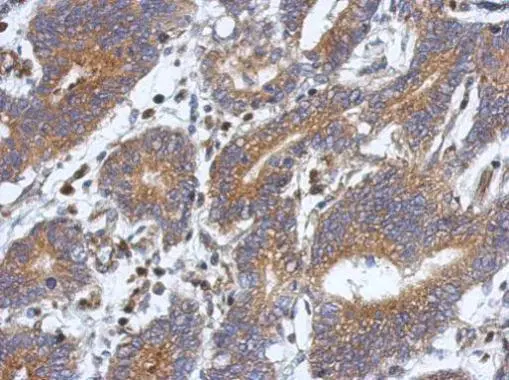

GTX105440
ATXN10 antibody

Eine Lieferung in diese Region ist nicht möglich.
- SKU:
- GTX105440
- Zusätzliche Namen:
- ataxin 10 , E46L , HUMEEP , SCA10
- Anwendung:
- WB, IHC-P
- Konzentration:
- 0.78 mg/ml
- Physischer Zustand:
- Liquid
- Spezies-Reaktivität:
- Human
- Aufreinigung:
- Affinity Purified
- Lagerbedingungen:
- -20[o]C Aliquot. Avoid freeze/thaw cycles. Store undiluted., 2-8[o]C Aliquot. Avoid freeze/thaw cycles. Store undiluted., -20[o]C/-70[o]C Aliquot. Avoid freeze/thaw cycles. Store undiluted.
- Hersteller:
- Genetex
- Host:
- Rabbit
- Reaktivitäten:
- Human
- Buffer:
- PBS, 1% BSA, 20% Glycerol, 0.01% Thimerosal.
- Immunogen:
- Recombinant protein encompassing a sequence within the center region of human ATXN10. The exact sequence is proprietary.
- Uniprot:
- Q9UBB4
- Synonyme:
- ataxin-10;brain protein E46 homolog;E46L;HUMEEP;SCA10;spinocerebellar ataxia type 10 protein
- Weitere Details:
- The autosomal dominant cerebellar ataxias (ADCAs) are a clinically and genetically heterogeneous group of disorders characterized by ataxia, dysarthria, dysmetria, and intention tremor. All ADCAs involve some degree of cerebellar dysfunction and a varying degree of signs from other components of the nervous system. A commonly accepted clinical classification (Harding, 1993) divides ADCAs into 3 different groups based on the presence or absence of associated symptoms such as brainstem signs or retinopathy. The presence of pyramidal and extrapyramidal symptoms and ophthalmoplegia makes the diagnosis of ADCA I, the presence of retinopathy points to ADCA II, and the absence of associated signs to ADCA III. Genetic linkage and molecular analyses revealed that ADCAs are genetically heterogeneous even within the various subtypes.[supplied by OMIM]
- Versandbedingungen:
- Blue Ice