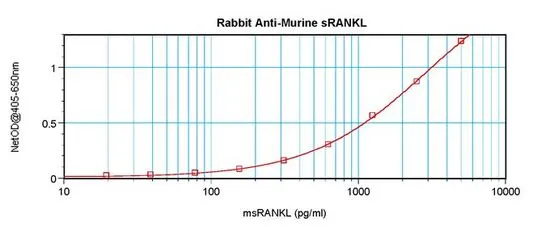
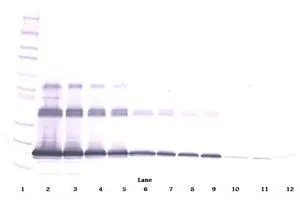
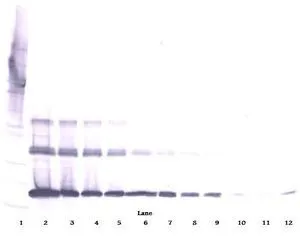
GTX10343
sRANKL antibody

Eine Lieferung in diese Region ist nicht möglich.
- SKU:
- GTX10343
- Zusätzliche Namen:
- tumor necrosis factor (ligand) superfamily, member 11 , Ly109l , ODF , OPGL , RANKL , Trance
- Anwendung:
- ELISA, WB
- Physischer Zustand:
- Liquid
- Spezies-Reaktivität:
- Mouse
- Aufreinigung:
- Affinity Purified
- Lagerbedingungen:
- -20[o]C Aliquot. Avoid freeze/thaw cycles. Store undiluted., 2-8[o]C Aliquot. Avoid freeze/thaw cycles. Store undiluted., -20[o]C/-70[o]C Aliquot. Avoid freeze/thaw cycles. Store undiluted.
- Hersteller:
- Genetex
- Host:
- Goat
- Reaktivitäten:
- Mouse
- Buffer:
- PBS, no preservatives.
- Immunogen:
- Produced from sera of rabbits pre-immunized with highly pure (>98%) recombinant msRANKL (murine sRANK Ligand).
- Uniprot:
- O35235
- Synonyme:
- Ly10;Ly109l;O;OD;ODF;OPG ligand;OPGL;osteoclast differentiation factor;osteoprotegerin ligand;R;RANKL;receptor activator of NF-kappaB ligand;receptor activator of nuclear factor kappa-B ligand;TNF-related activation-induced cytokine;Tra;Trance;tumor necrosis factor ligand superfamily member 11;tumor necrosis factor-related activation-induced cytokine
- Weitere Details:
- TRANCE, also called RANKL (RANK ligand), OPGL (Osteoprotegrin ligand), and ODF (Osteoclast differentiation factor), is a type II transmembrane signaling protein of the TNF superfamily. The extracellular domain contains two potential N-linked glycosylation sites. Mouse TRANCE cDNA encodes a 316 amino acid protein with a calculated molecular mass of approximately 28 kDa. As a result of glycosylation, recombinant mouse TRANCE migrates as an approximately 36 kDa protein in SDS-PAGE. Human and mouse TRANCE share approximately 85% amino acid sequence identity. TRANCE was originally identified as an immediate early gene upregulated by T cell receptor stimulation. It is a key regulator of the immune system and of bone development and homeostasis. Multi-functions of TRANCE include induction of activation of c-jun N-terminal kinase in T cells, enhancement of T cell growth and dendritic cell function, induction of osteoclastogenesis and lymph node organogenesis. The cell surface signaling receptor of TRANCE (RANKL) is RANK which undergoes receptor clustering during signal transduction. TRANCE is highly expressed in thymus and lymph nodes but not in nonlymphoid tissues.1 It is abundantly expressed in T cells but not in B cells. TRANCE activates mature dendritic cells, inducing cytokine production, suggesting that it is a factor in the T cell dentritic cell interaction during an immune response. TRANCE expression is found on osteoblasts and regulates osteoclast differentiation function.
- Versandbedingungen:
- Blue Ice