BNUM3799
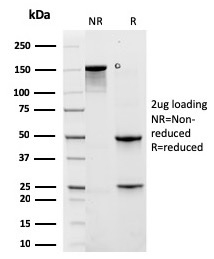
Cytokeratin 6A (KRT6A) (Basal Cell Marker)(rKRT6A/2100), 1mg/mL

Eine Lieferung in diese Region ist nicht möglich.
- SKU:
- BNUM3799
- Zusätzliche Namen:
- 58kDa Cytokeratin; CK5; Cytokeratin-5; DDD1; Epidermolysis Bullosa Simplex 2 (EBS2); Keratin 5; Keratin; Type II Cytoskeletal 5; Keratin-5; KRT5; Type-II Cytoskeletal 5; Type-II keratin Kb5
- Anwendung:
- IHC-P
- Konzentration:
- 1 mg/ml
- Molekulargewicht:
- 58 kDa
- Quelle:
- Animal
- Lagerbedingungen:
- -20[o]C Avoid freeze/thaw cycles.
- Hersteller:
- Biotium
- Host:
- Mouse
- Reaktivitäten:
- Human, Mouse
- Buffer:
- PBS, no BSA, no azide|PBS, no BSA, no sodium azide
- Immunogen:
- Recombinant full-length human Cytokeratin 6A (KRT6A) protein
- Formulierung:
- PBS, no BSA, no azide
- Klon:
- rKRT6A/2100
- Uniprot:
- P02538
- Synonyme:
- CK-6C;CK-6E;CK6A;CK6C;CK6D;cytokeratin 6A;cytokeratin 6C;cytokeratin 6D;Cytokeratin-6A;Cytokeratin-6D;K6A;K6C;K6D;keratin 6A, , type II;keratin 6A, type II;Keratin-6A;keratin, epidermal type II, K6A;keratin, type II cytoskeletal 6A;KRT6C;KRT6D;PC3;type-II keratin Kb6
- Weitere Details:
- This MAb recognizes a protein of 56 kDa, identified as cytokeratin 6A (KRT6A). In humans, multiple isoforms of Cytokeratin 6 (6A-6F), encoded by several highly homologous genes, have distinct tissue expression patterns. Cytokeratin 6A is the dominant form in epithelial tissue. Cytokeratin 6 and 16 are expressed in keratinocytes, which are undergoing rapid turnover in the suprabasal region (also known as hyper-proliferation-related keratins). Cytokeratin 6 is found in hair follicles, suprabasal cells of a variety of internal stratified epithelia, in epidermis, in both normal and hyper-proliferative situations. Epidermal injury results in activation of keratinocytes, which express KRT6 and KRT16. KRT6 is strongly expressed in about 75% of head and neck squamous cell carcinomas. Primary antibodies are available purified, or with a selection of fluorescent CF® Dyes and other labels. CF® Dyes offer exceptional brightness and photostability. Note: Conjugates of blue fluorescent dyes like CF®405S and CF®405M are not recommended for detecting low abundance targets, because blue dyes have lower fluorescence and can give higher non-specific background than other dye colors.
- Versandbedingungen:
- Ambient