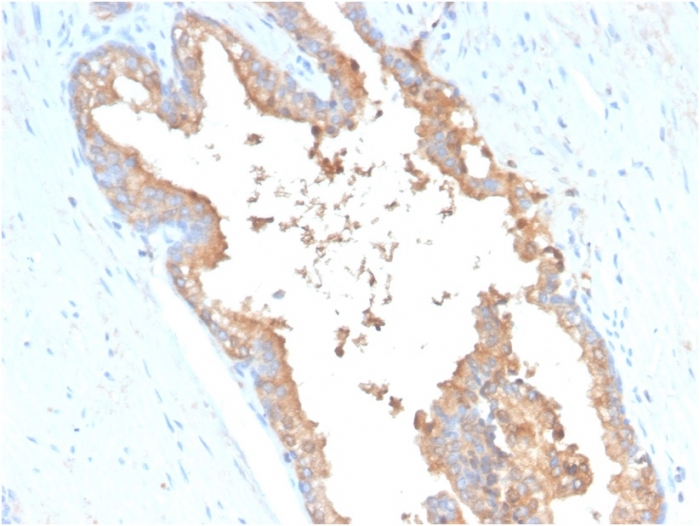
BNUM3001
Transferrin (Early Marker of Oligodendrocytes)(TF/3001), 1mg/mL

Eine Lieferung in diese Region ist nicht möglich.
- SKU:
- BNUM3001
- Zusätzliche Namen:
- Apotransferrin; Beta-1 metal-binding globulin; Serotransferrin; Siderophilin; TF; TFQTL1; Transferrin
- Anwendung:
- IHC-P
- Konzentration:
- 1 mg/ml
- Molekulargewicht:
- 79 kDa
- Quelle:
- Animal
- Lagerbedingungen:
- -20[o]C Avoid freeze/thaw cycles.
- Hersteller:
- Biotium
- Host:
- Mouse
- Reaktivitäten:
- Human, Mouse
- Buffer:
- PBS, no BSA, no azide|PBS, no BSA, no sodium azide
- Immunogen:
- Recombinant fragment (around aa 311-445) of human TF protein (exact sequence is proprietary)
- Formulierung:
- PBS, no BSA, no azide
- Klon:
- TF/3001
- Uniprot:
- P02787
- Synonyme:
- beta-1 metal-binding globulin;epididymis secretory sperm binding protein Li 71p;HEL-S-71p;PRO1557;PRO2086;serotransferrin;siderophilin;TFQTL1
- Weitere Details:
- Iron (Fe) is a tightly metabolically controlled mineral and growth factor present in all living cells. Iron not bound in erythrocyte hemoglobin is transported by transferrin (Tf), the iron transport protein of vertebrate serum. The transferrin protein contains two homologous domains, each of which contain an Fe-binding site. The majority of transferrin is synthesized in the liver and secreted into the blood, but it is also produced in lower amounts in testis and brain as well as in oligodendrocytes, where transferrin is an early marker of oligodendrocyte differentiation. From the blood, transferrin is internalized by erythroblasts and reticulocytes upon binding the transferrin receptor (TfR), also designated CD71, through a system of coated pits and vesicles. After Fe release, transferrin is returned to the extracellular medium, where it can be reused. Defects in the transferrin gene results in atransferrinemia, a rare autosomal recessive disorder characterized by microcytic anemia and iron loading. Primary antibodies are available purified, or with a selection of fluorescent CF® Dyes and other labels. CF® Dyes offer exceptional brightness and photostability. Note: Conjugates of blue fluorescent dyes like CF®405S and CF®405M are not recommended for detecting low abundance targets, because blue dyes have lower fluorescence and can give higher non-specific background than other dye colors.
- Versandbedingungen:
- Ambient