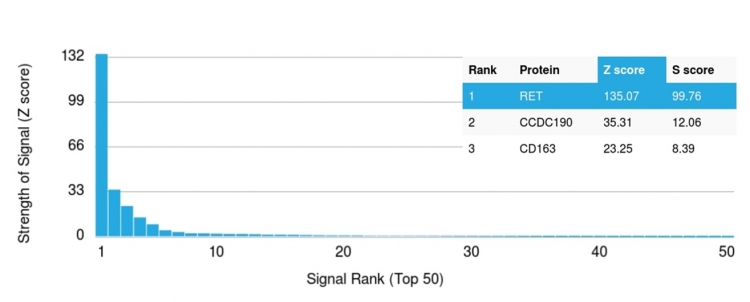
BNUM2976
RET Proto-oncogene(RET/2976), 1mg/mL

Eine Lieferung in diese Region ist nicht möglich.
- SKU:
- BNUM2976
- Zusätzliche Namen:
- Cadherin family member 12 (CDHF12); Cadherin related family member 16 (CDHR16); ELKS; HSCR1; Hydroxyaryl protein kinase; MEN2A; MEN2B; MTC1; Multiple endocrine neoplasia and medullary thyroid carcinoma 1; Oncogene RET; Proto-oncogene c-Ret; Proto-oncogene tyrosine-protein kinase receptor ret; PTC; RET; RET ELE1; RET51; RET9
- Konzentration:
- 1 mg/ml
- Molekulargewicht:
- 150 kDa (precursor); 170 kDa (Mature)
- Quelle:
- Animal
- Lagerbedingungen:
- -20[o]C Avoid freeze/thaw cycles.
- Hersteller:
- Biotium
- Host:
- Mouse
- Reaktivitäten:
- Human, Mouse
- Buffer:
- PBS, no BSA, no azide|PBS, no BSA, no sodium azide
- Immunogen:
- Recombinant fragment (around aa 702-848) of human RET protein (exact sequence is proprietary)
- Formulierung:
- PBS, no BSA, no azide
- Klon:
- RET/2976
- Uniprot:
- P07949
- Synonyme:
- cadherin family member 12;cadherin-related family member 16;CDHF12;CDHR16;HSCR1;MEN2A;MEN2B;MTC1;proto-oncogene c-Ret;proto-oncogene tyrosine-protein kinase receptor Ret;PTC;rearranged during transfection;ret proto-oncogene (multiple endocrine neoplasia and medullary thyroid carcinoma 1, Hirschsprung disease);RET receptor tyrosine kinase;RET-ELE1
- Weitere Details:
- The Ret proto-oncogene is structurally related to the growing family of tyrosine kinase transmembrane receptors and is involved in GDNF signaling. RET expression is reported in several regions of the central nervous system; in the developing cranial nerve ganglia and a subset of cells within dorsal root ganglia, in motor neurons in the spinal cord and hindbrain, in neuro-retina and the growing tips of the renal collecting ducts in developing kidney. Alterations in RETgene are associated with diseases including papillary thyroid carcinoma, multiple endocrine neoplasia (type 2A and 2B), familial medullary thyroid carcinoma, and a congenital developmental disorder known as Hirschsprung's disease. Primary antibodies are available purified, or with a selection of fluorescent CF® Dyes and other labels. CF® Dyes offer exceptional brightness and photostability. Note: Conjugates of blue fluorescent dyes like CF®405S and CF®405M are not recommended for detecting low abundance targets, because blue dyes have lower fluorescence and can give higher non-specific background than other dye colors.
- Versandbedingungen:
- Ambient